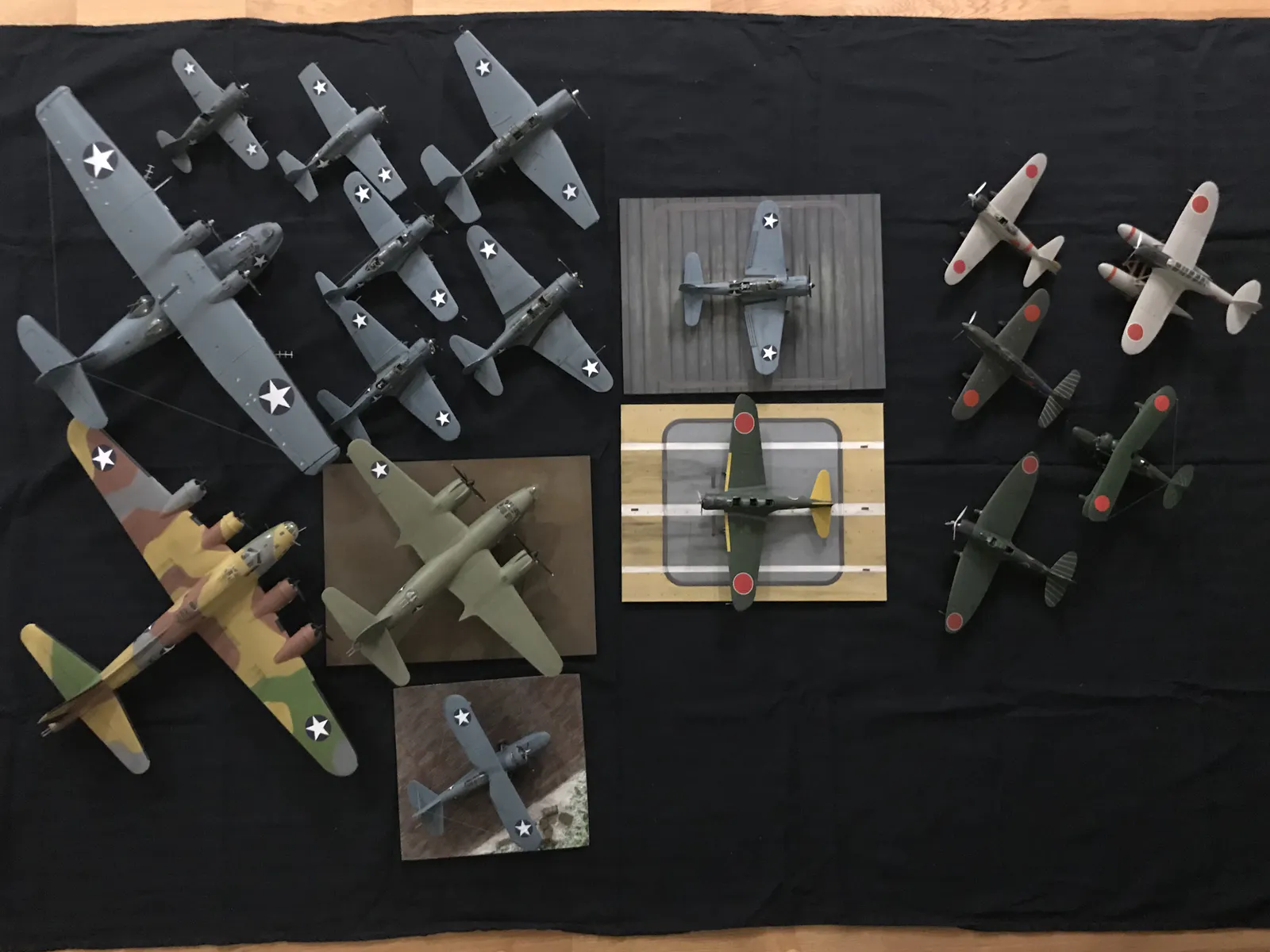
For the second time in the Pacific War — the first being the Battle of the Coral Sea — an entire engagement had been decided solely by aerial combat. The primacy of the carrier had been thoroughly established. It was the turning point of the war in the Pacific: from this moment on, the tide began to turn against Japan. The loss of four fleet carriers in a single day was a blow impossible to compensate.
The defending Americans had faced a formidable opponent and paid a heavy price — many pilots lost their lives on June 4. As so often in war, a measure of luck proved decisive. The Dauntlesses arrived over the Japanese fleet, after wandering in search of the carriers, at precisely the right moment — just as the CAP had descended to sea level to deal with the torpedo planes, leaving the sky above completely unguarded. After every torpedo attack had failed, the dive bombers were able to tip the balance.
The Catalinas continued to patrol the waters northwest of Midway for many days afterwards, searching for the Japanese and picking up survivors from the battle. Many victims, however, simply vanished into the vast ocean.
The battle marked the retirement and introduction of several aircraft types. The Devastator was never again used as a carrier-based torpedo plane — having lost 35 of 41 aircraft, its limitations had been brutally exposed. No Devastator survives to this day, though several wrecks are known to lie on the seabed. The E8N ‘Dave’ had already been phased out before Midway and was in the process of being replaced by the E13A ‘Jake’ and F1M ‘Pete’; Midway was its final action. The B-26 Marauder was still being shipped out to the Pacific when it was diverted to Midway, seeing action there for one of the first times — an odd choice as a torpedo platform. It went on to become a successful medium bomber, primarily in the European theatre. The Avenger made its combat debut at Midway, with only one of the six island-based aircraft surviving. It was sent back to Hawaii for thorough analysis and soon replaced the Devastator as the Navy’s primary carrier torpedo bomber. The D4Y ‘Judy’ also saw its first action at Midway — not as the dive bomber it was designed to be, but as a scout. It later replaced the D3A as the standard Japanese carrier dive bomber, and was also used as a night fighter and as a kamikaze aircraft.
Building this project was as stimulating as it was demanding. My modelling skills developed considerably in the process, but above all I came away with a much deeper knowledge of a pivotal moment in history. There is also a smaller companion project that can be seen as a direct sequel — the interception and killing of Admiral Yamamoto at Bougainville, known as Operation Vengeance.