Painting is only half the battle — getting clean edges between colours is where patience really pays off. Here’s what I’ve learned about masking.
The Masked Hero
The tape
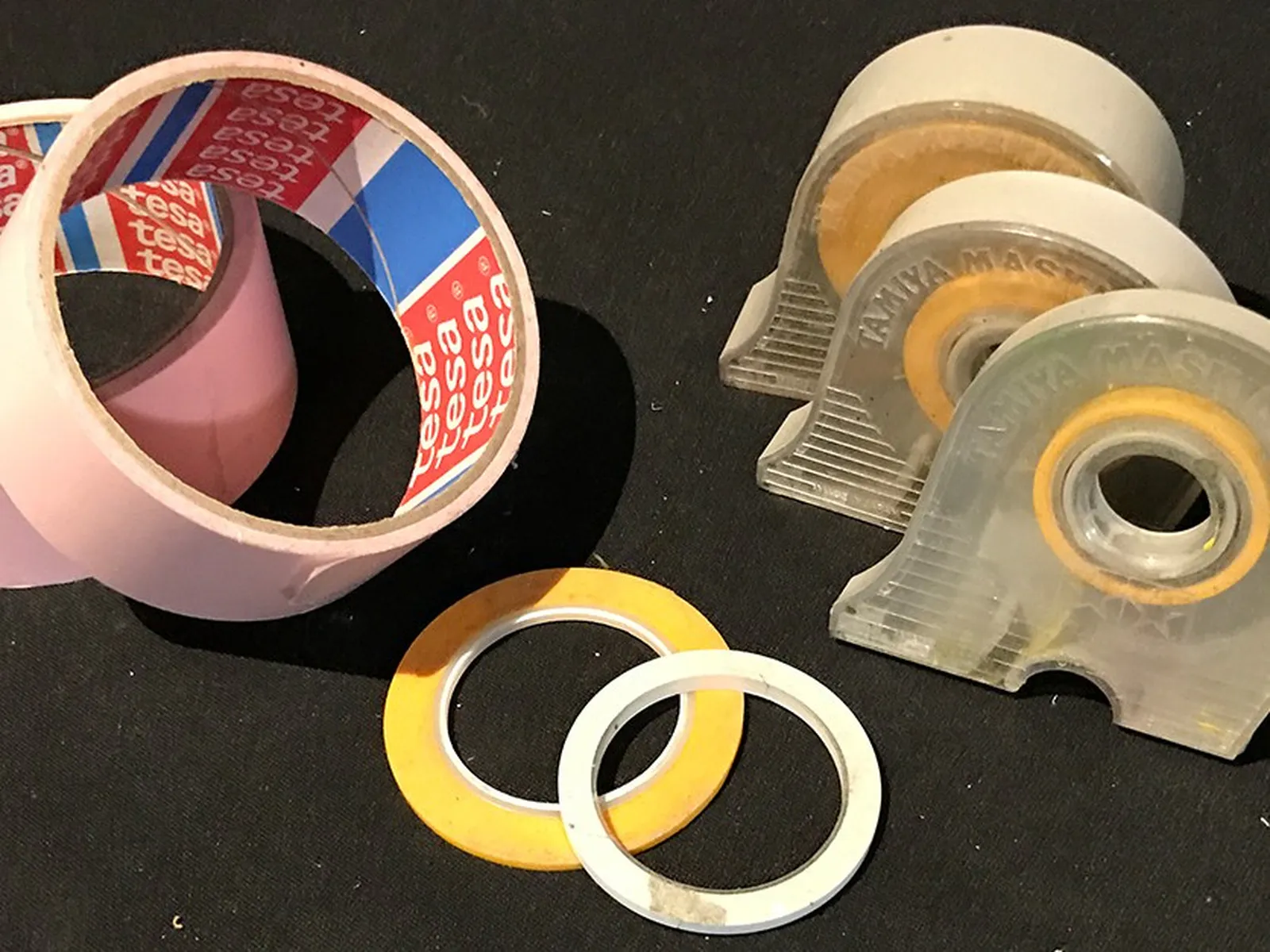
Masking tape for hobby use comes in several varieties and it's worth knowing the differences. For most tasks I use Tamiya's masking tape, which comes in different widths in a convenient dispenser. It's gentle on painted surfaces, which matters more than you might think — especially with acrylic paint. For covering larger areas I use a wider precision tape from Tesa, bought at a hardware store. It covers more ground and is even gentler on the paint beneath.
For tight curves or very narrow areas there are flexible masking tapes, also from Tamiya, available in widths down to 2mm. These bend well around reasonable curves while still adhering cleanly. The one thing to watch is that they're slightly thicker than standard tape, which can leave a small paint ridge along the edge if you're not careful when removing them.
For tight curves or very narrow areas there are flexible masking tapes, also from Tamiya, available in widths down to 2mm. These bend well around reasonable curves while still adhering cleanly. The one thing to watch is that they're slightly thicker than standard tape, which can leave a small paint ridge along the edge if you're not careful when removing them.
The liquid mask
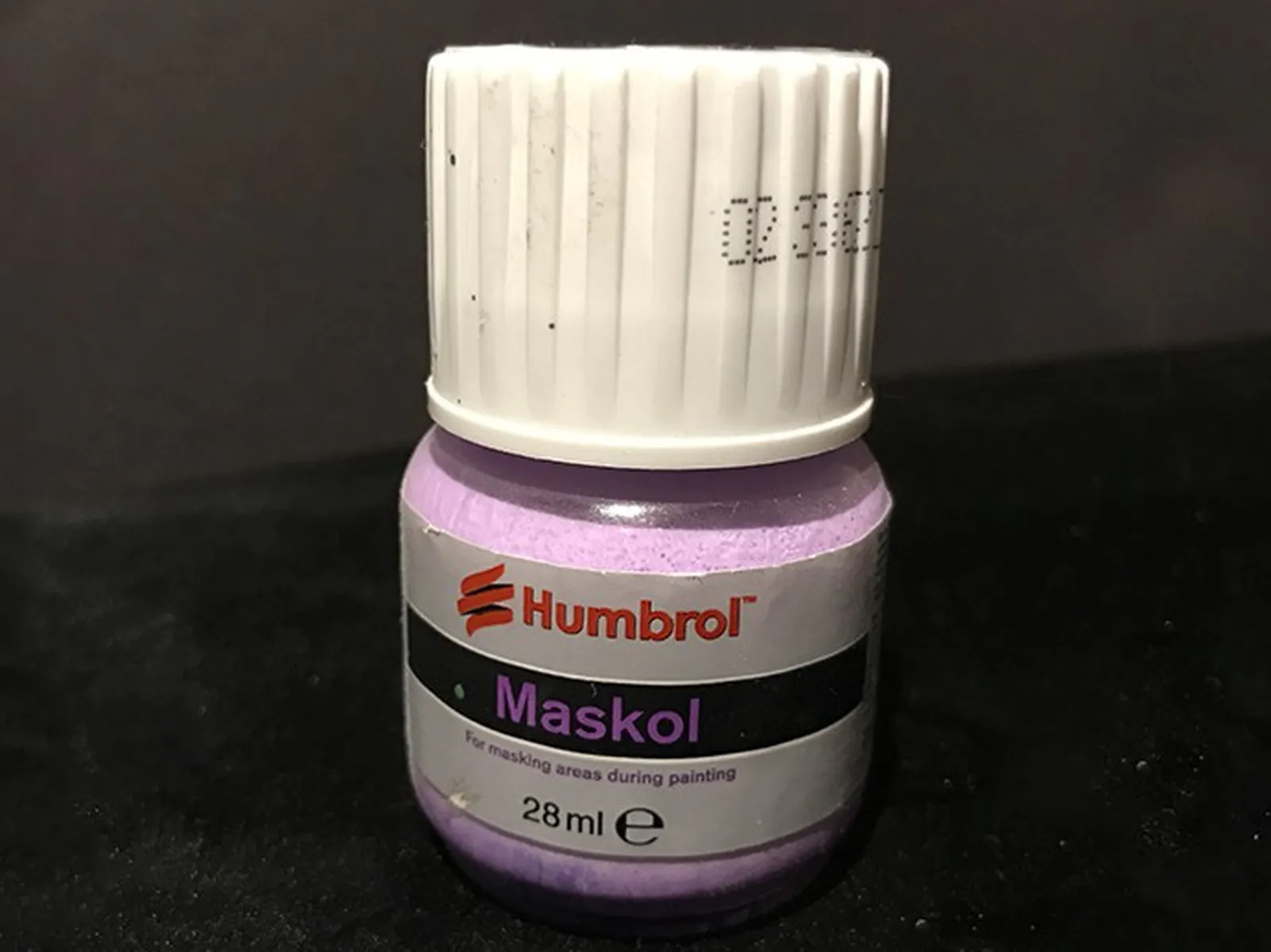
Where tape struggles — on bulging or complex curved surfaces where it tends to fold and lift — liquid mask is the answer. Humbrol's Maskol is a good example. You brush it on, let it dry, and paint over it. When you're done it peels off cleanly.
The slightly unnerving thing about it is that it dries to an almost invisible coat, which makes it hard to be certain you've covered everything properly. Work methodically and don't rush it. When it's time to remove it, it peels away easily and leaves the surface beneath untouched.
The slightly unnerving thing about it is that it dries to an almost invisible coat, which makes it hard to be certain you've covered everything properly. Work methodically and don't rush it. When it's time to remove it, it peels away easily and leaves the surface beneath untouched.
The masking putty
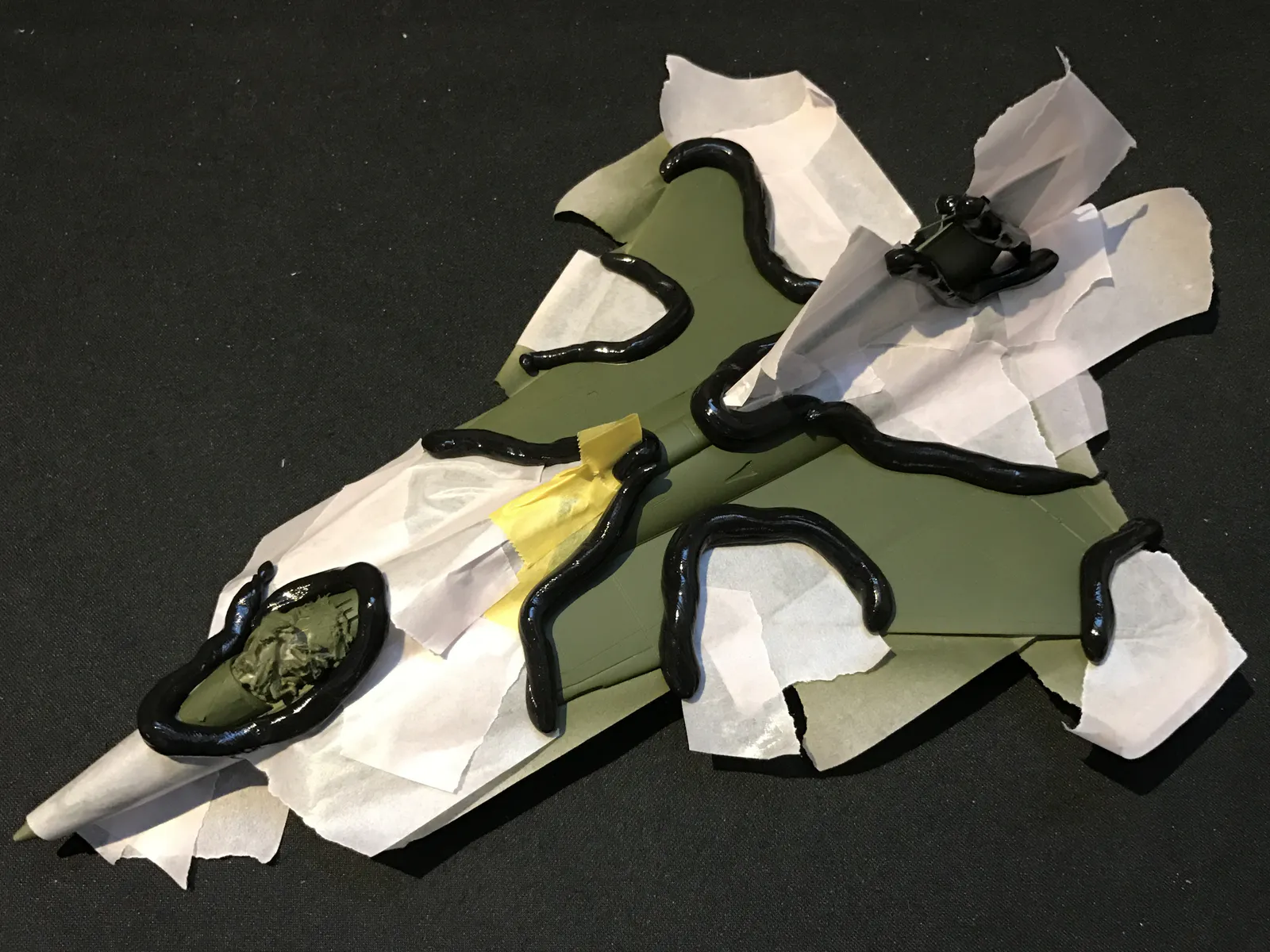
Putty might seem like an odd masking material, but it has a specific and very useful purpose. Most camouflage schemes on military aircraft and vehicles have soft, indistinct edges between colours — because in real life they were sprayed on with large airbrushes. Recreating that effect with tape alone is difficult, as tape gives you a hard edge.
The solution is to line the edges of your masked area with thin rolls of tack putty and paint from directly above. The colour fades out naturally at the edges, giving exactly the right softness. You can see in the picture that I'm using dedicated masking putty — but I've since learned that ordinary tack putty works just as well, and is easier to handle. It's what I use today.
The solution is to line the edges of your masked area with thin rolls of tack putty and paint from directly above. The colour fades out naturally at the edges, giving exactly the right softness. You can see in the picture that I'm using dedicated masking putty — but I've since learned that ordinary tack putty works just as well, and is easier to handle. It's what I use today.
The how
Masking can be straightforward or it can test your patience — it depends on what you're trying to achieve. Simple panel-aligned colour separations are easy enough. Camouflage schemes are where it gets more involved, and where good reference pictures become essential. Paint instructions aren't always accurate, but then again — who's going to hold you responsible for a slightly imperfect pattern, as long as it looks good?
When using an airbrush, masking everything that shouldn't get paint is critical. It takes only a moment of misdirection to do damage that takes much longer to fix. I always err on the side of masking too much rather than too little, and I make sure the tape is adhering properly all the way along every edge — paint creeping under the tape is one of the most dispiriting things to discover when you unmask.
It's also good practice to leave as many separate parts off the model as possible until after painting — propellers, landing gear, pitot tubes. They get in the way, they're prone to breaking during masking, and they're usually a different colour anyway. Just make sure you've thought through how they'll attach afterwards. Realising too late that a landing gear can't be fitted without surgery is not a good moment.
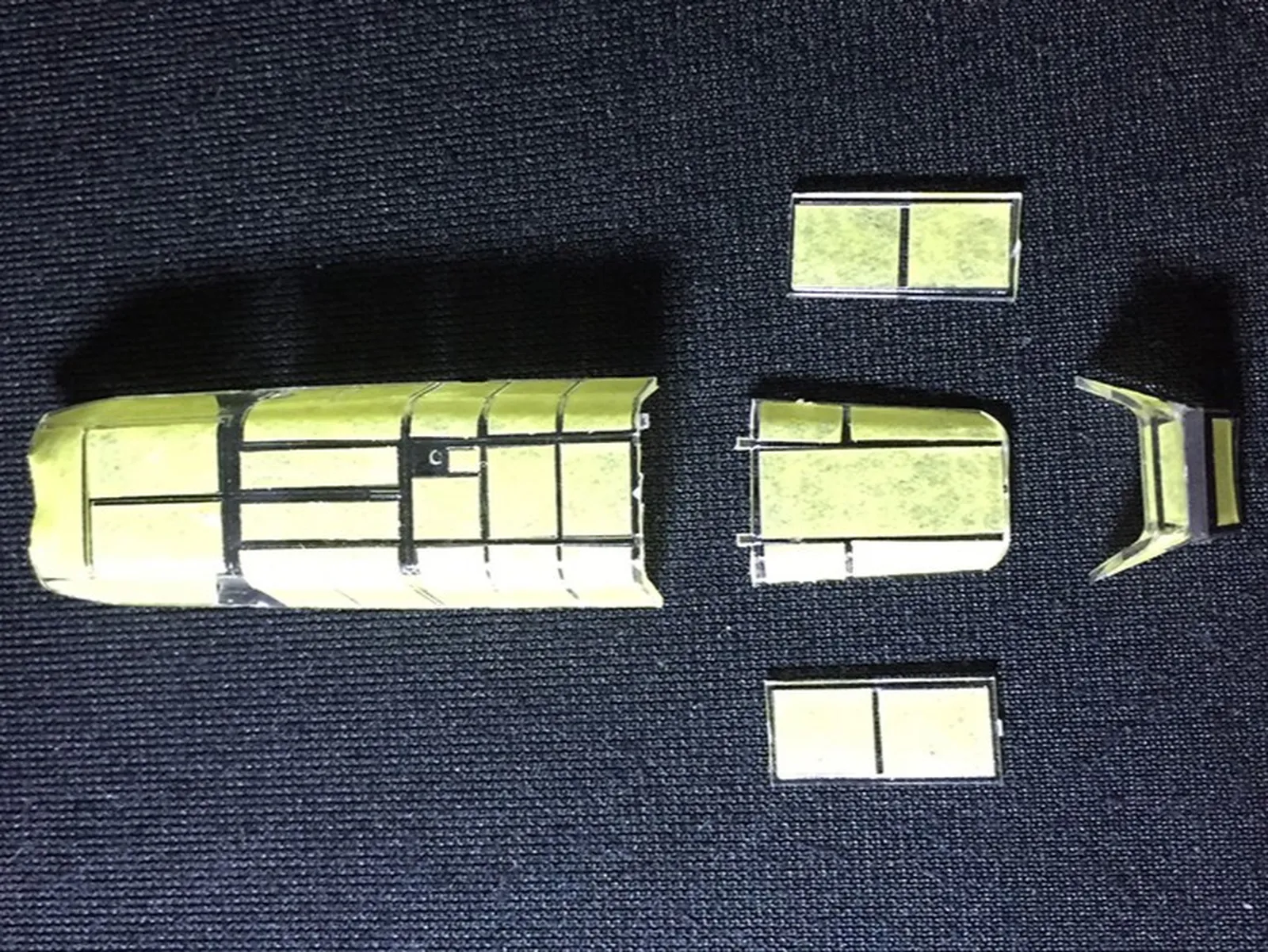
Canopies deserve special mention. I prefer to cement them in place before painting, as the join is otherwise very hard to finish neatly. Mask carefully, leaving the frames exposed for painting, and fill the rest of the glazed area with liquid mask. If you don't have a ready-made mask, tape over the canopy and cut carefully along the frames with a scalpel — holding a light behind it helps you see the lines through the tape.
When using an airbrush, masking everything that shouldn't get paint is critical. It takes only a moment of misdirection to do damage that takes much longer to fix. I always err on the side of masking too much rather than too little, and I make sure the tape is adhering properly all the way along every edge — paint creeping under the tape is one of the most dispiriting things to discover when you unmask.
It's also good practice to leave as many separate parts off the model as possible until after painting — propellers, landing gear, pitot tubes. They get in the way, they're prone to breaking during masking, and they're usually a different colour anyway. Just make sure you've thought through how they'll attach afterwards. Realising too late that a landing gear can't be fitted without surgery is not a good moment.
Canopies deserve special mention. I prefer to cement them in place before painting, as the join is otherwise very hard to finish neatly. Mask carefully, leaving the frames exposed for painting, and fill the rest of the glazed area with liquid mask. If you don't have a ready-made mask, tape over the canopy and cut carefully along the frames with a scalpel — holding a light behind it helps you see the lines through the tape.