In December 1941 Richard E. Fleming was posted to VMSB-231 when the squadron flew their Vought SB2U-3 Vindicators from Ewa Field in Hawaii to Midway — a distance of 1,137 miles that set a record for the longest formation flight by single-engined aircraft. At Midway the group was split, and Fleming joined VMSB-241 under Major Henderson. In the build-up before the battle the squadron received 18 SBD-2 Dauntlesses phased out by the Navy, and Fleming was assigned one of them. Ten new pilots had also joined just ten days before the battle, leaving too little time and too little fuel for proper training. Henderson decided to use glide bombing as the only practical tactic.
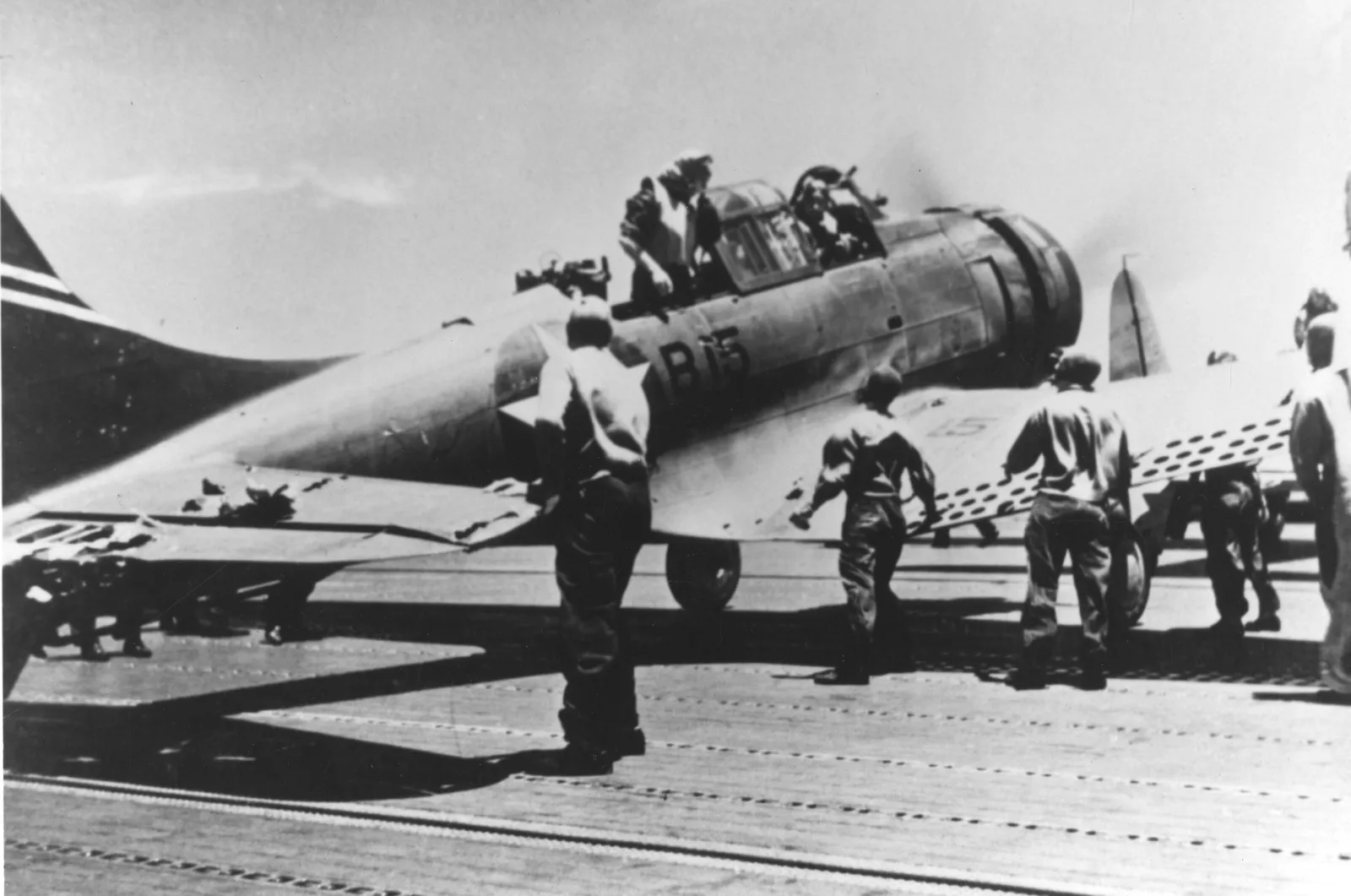
The attack VMSB-241 made on the Japanese fleet on June 4 is described in the chapter on the SBD-2 Dauntless. Fleming returned from that mission having made a daring glide bomb run on one of the carriers, pulling out at 400 feet. With 179 holes in his plane and one shot-out tyre he put it down neatly at Midway and stepped out saying “Boys, there is one ride I am glad is over.” Fleming was only lightly wounded, but his gunner Corporal Eugene Card was carried off on a stretcher. Their Dauntless was written off.
Fleming was then assigned one of the Vindicators, “White 2”, together with the plane’s regular gunner Private First Class George Toms. They were sent out the same day to search for a burning carrier that had been reported. The search was unsuccessful, and as night fell their Squadron Commander Norris became separated from the others. Despite dangerous weather and total darkness the rest of the squadron made it back safely, but Norris never returned.
After only four hours’ sleep they were sent out again the next morning in two groups — six Dauntlesses and six Vindicators. Fleming had been made leader of the Vindicator group following Norris’ disappearance. This time they were sent to find the remnants of the Japanese fleet, primarily the surviving battleships after the loss of the carriers.
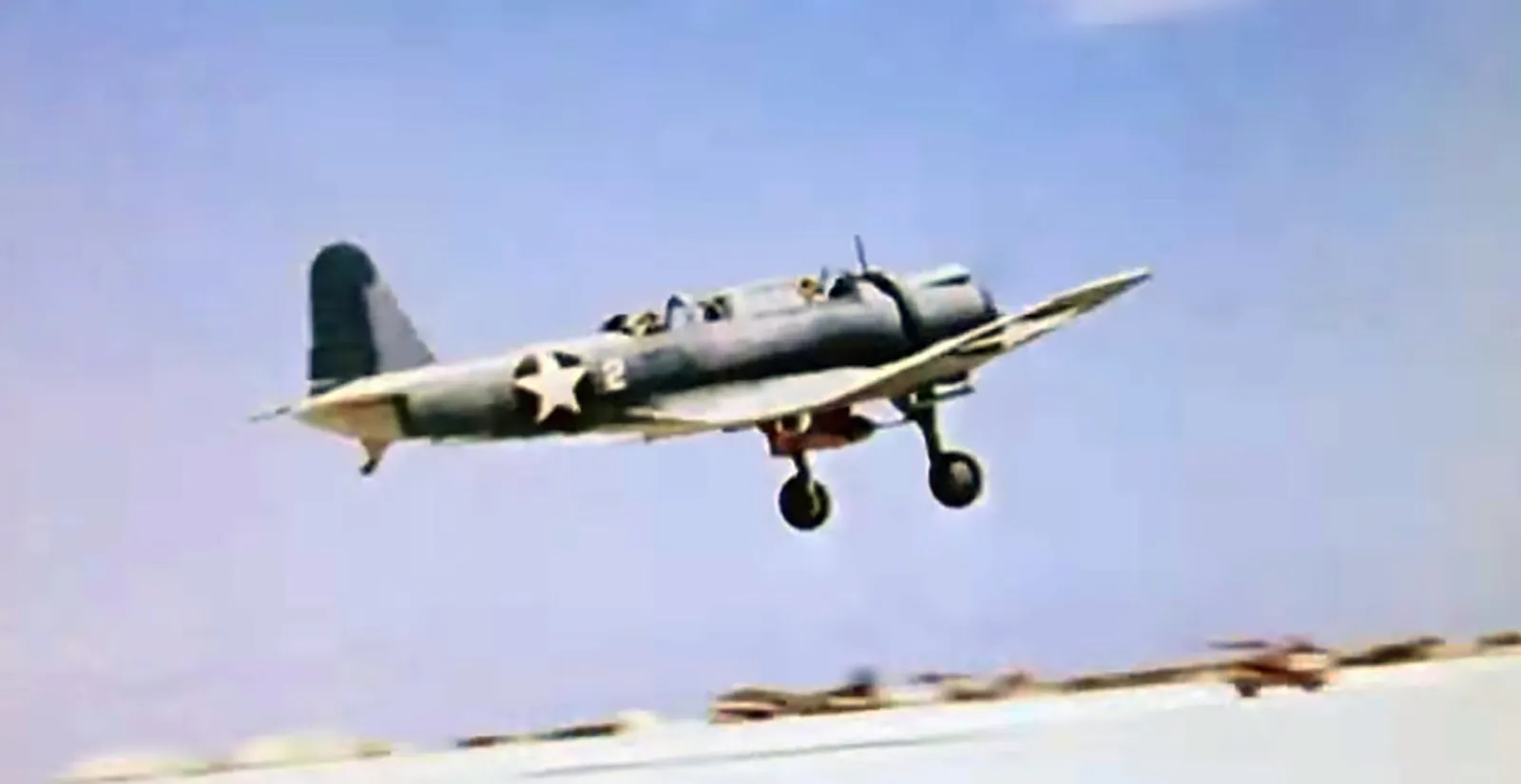
At around 7:45 one of the pilots spotted an oil slick, and following it they found two cruisers sailing alone — the Mogami and the Mikuma, severely damaged not by American action but by a collision with each other. The group immediately attacked. The cruisers answered with fierce AA fire. Fleming went into a glide run against the Mikuma, but smoke soon began streaming from his plane, followed by flames. Somehow he held his course. He released his bomb at 500 feet — and then crashed into the sea. Neither the bomb nor the aircraft struck the cruiser.
Fleming was posthumously awarded the Medal of Honor, the highest American military decoration. He was the first Marine pilot to receive it in the Second World War, and the only recipient for actions during the entire Battle of Midway. His gunner Toms received the Distinguished Flying Cross. The Mikuma was sunk the following day by Dauntlesses from USS Enterprise and USS Hornet.
As described in the chapter on the Val, Joichi Tomonaga had led the attack on Midway that morning, during which his Kate’s left fuel tank was damaged. He managed to return to his carrier Hiryū. Shortly after, the ship survived the devastating Dauntless attacks that set the Akagi, Kaga and Sōryū ablaze — Hiryū had manoeuvred clear and remained the only operational Japanese carrier. She immediately launched a strike of 18 Vals and 6 Zeros against USS Yorktown, which had been located by a reconnaissance plane from the cruiser Chikuma. The attack was met with fierce resistance — thirteen Vals and three Zeros were shot down — but they still managed to score several hits on the Yorktown.
Soon after, one of Sōryū’s Judys returned with the startling news that there were in fact three American carriers in the vicinity. A new strike force was quickly assembled under Tomonaga’s lead, consisting of 10 Kates and 6 Zeros. His left fuel tank was still perforated, and he was asked to switch to another aircraft. He refused, pointing out that every plane was needed. He simply ordered the ground crew to fill his right tank and took off, fully aware that he had fuel for a one-way trip only.
They were ordered to attack one of the two undamaged American carriers, targeting the Yorktown only if the others could not be found. Around 14:00 they sighted what appeared to be an undamaged carrier — it was in fact the Yorktown, which had been so swiftly repaired that Tomonaga mistook her for a fresh ship. At 14:32 he radioed his group: “Take position in preparation for attack formation,” and two minutes later: “Entire force attack!” On the way in two Wildcats shot down one Kate before being themselves brought down by the escorting Zeros. Closing in, the American CAP descended upon them and the AA fire intensified.

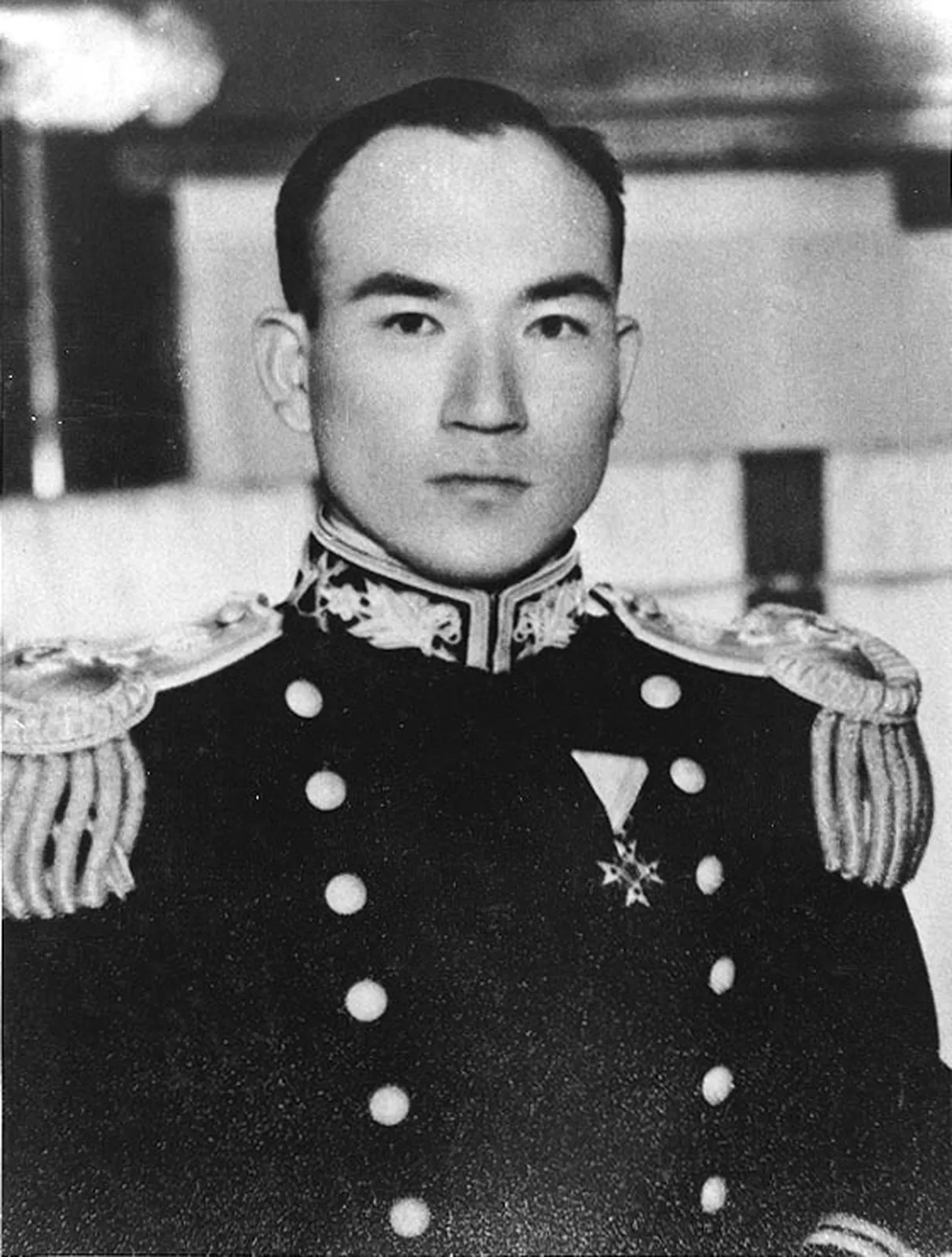
Tomonaga came in on the Yorktown from the aft port quarter, a Wildcat on his tail — possibly Jimmy Thach himself. Heavily damaged, he held his course and released his torpedo against the carrier. Immediately afterwards his left wing ruptured and he crashed into the sea. His torpedo missed its mark.
The Yorktown was nevertheless hit by two other torpedoes, one dropped by Lieutenant Toshio Hashimoto, leader of the second group of Kates. The hits crippled her so severely that she was later finished off by the Japanese submarine I-168. Hiryū did not escape either — that afternoon she was attacked by American dive bombers and eventually sunk, bringing the battle’s carrier exchange to a decisive conclusion.
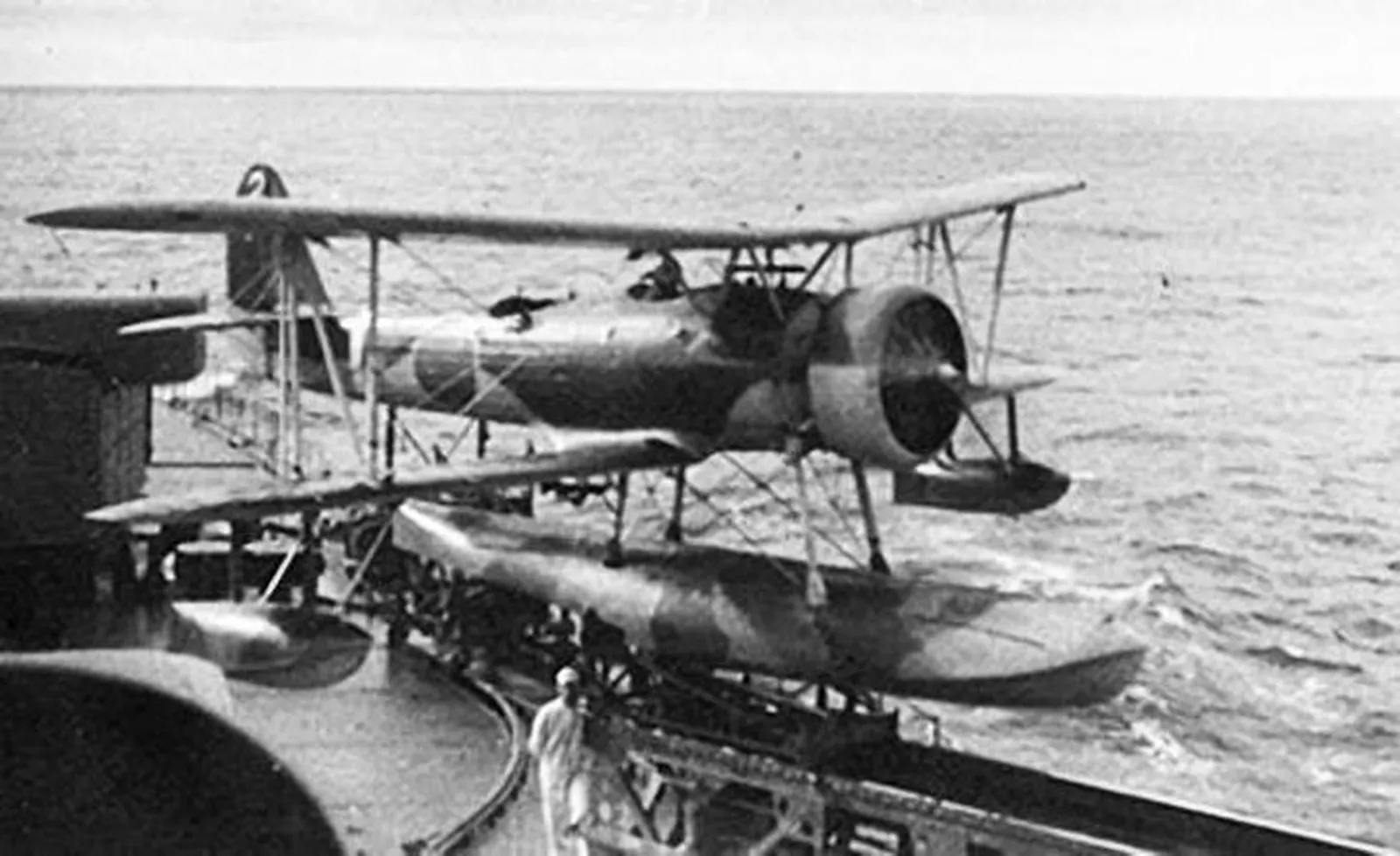
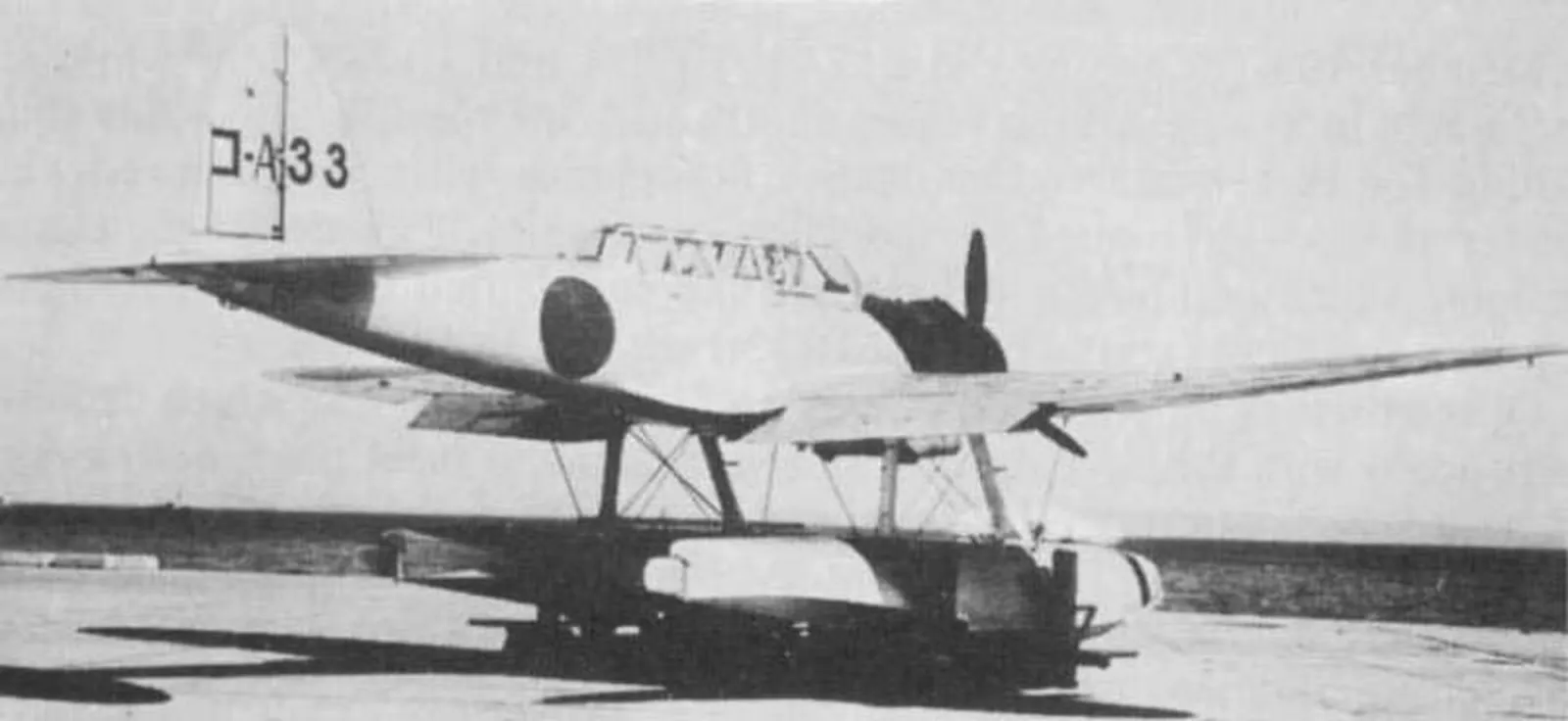
By the afternoon the Japanese knew there were more American carriers in the vicinity than they had initially thought — but how many? They launched several scout planes to find out. In addition to the Jakes and the Judy already described, five Nakajima E8N2 ‘Dave’ floatplanes were sent out from the tender Tone and the battleships Haruna and Kirishima. These were slower and had shorter range than the other scouts, but every available resource was now needed. Among them was No. 1 aircraft from the battleship Haruna.
Just as reports reached Rear Admiral Yamaguchi aboard Hiryū about Tomonaga’s attack on the Yorktown, a message came in from Haruna’s No. 1 scout. He was under attack by American fighters and believed carriers to be close by. The scout was considered as good as lost — an E8N2 was hardly a match for an American Wildcat.
The unnamed pilot aboard No. 1, however, turned out to possess exceptional airmanship. Rather than trying to outrun his pursuers, he used his plane’s very slowness to his advantage, manoeuvring to deny the faster American fighters a clean shot. With some cloud cover available he finally managed to shake them off. Limping back to the Japanese fleet he found his way to the Haruna. His observer/gunner had been killed, and the E8N2 would never fly again — but the pilot had survived against all odds.
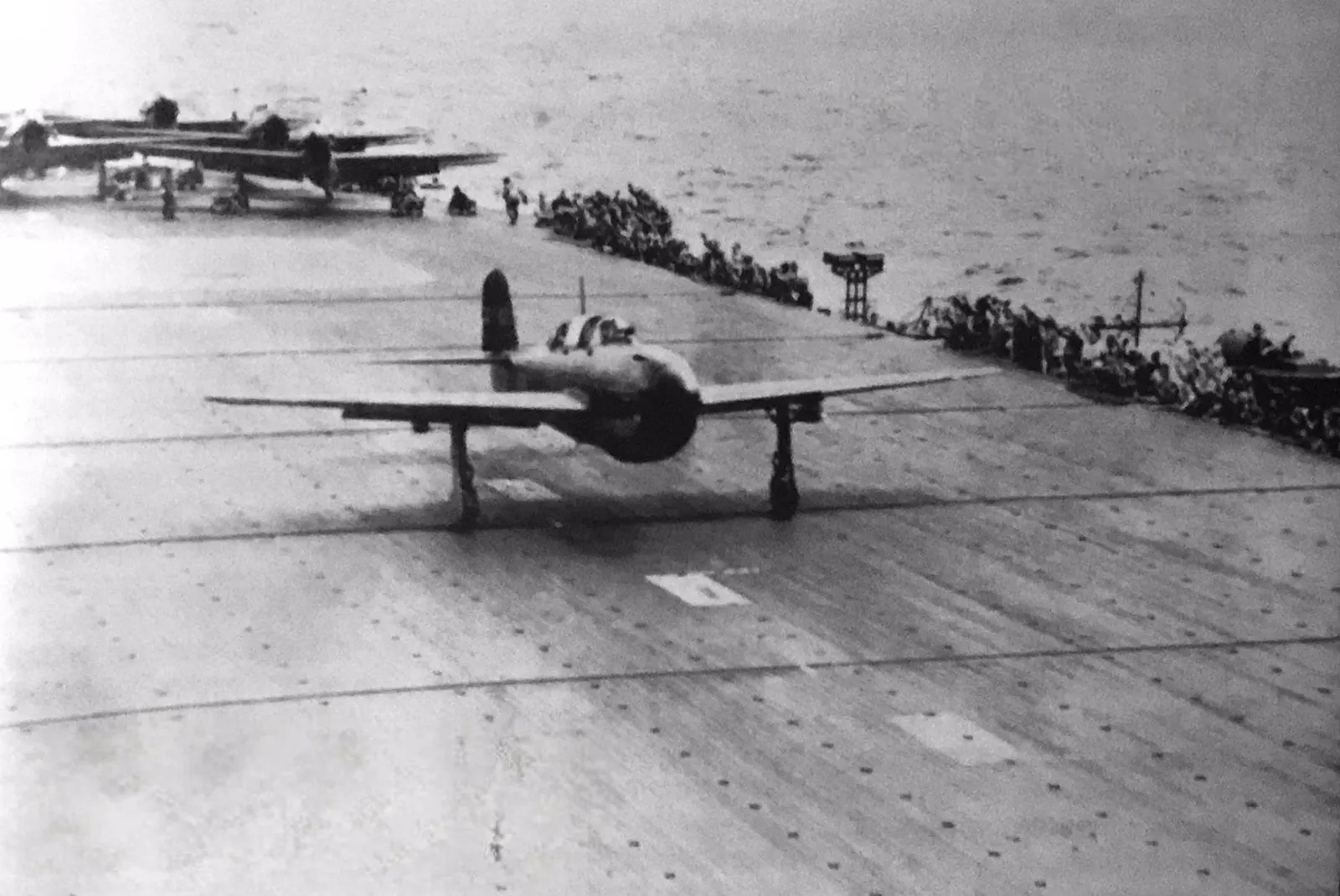
During the forenoon of June 4, Nagumo’s fleet still had only sketchy intelligence on the force opposing them. They had sighted just one American carrier, USS Yorktown. Aboard the carrier Sōryū, however, were two prototype versions of a new aircraft — the Yokosuka D4Y Type 2 Suisei, later named ‘Judy’ by the Allies. The D4Y had been designed as a dive bomber, but the first examples proved too unstable for that role. Their long range and high speed, however, made them useful as scouts, and so these two were now aboard Sōryū for exactly that purpose. One of them was sent off with specific instructions to find and identify the American force.
Pilot Officer First Class Iida Masatada and Wireless Operator Kondō Isamu climbed into their D4Y and took off, heading for the last known position of USS Yorktown. What they found astonished them — not one but three American carriers with escorts. They had located Task Force 16 with USS Enterprise and USS Hornet. They attempted to radio this back to the fleet, but the message never got through. Their radio, it later turned out, was unserviceable.
With the mission complete they turned back for Sōryū — only to find it ablaze. So too were the Akagi and the Kaga. Fortunately Hiryū was still intact. Her deck, however, was spotted with Tomonaga’s torpedo planes preparing for their second strike, so they flew past and dropped a message tube describing their sightings. At last the Japanese knew what they were up against. They then circled until the deck was clear, landing just ahead of Hiryū’s dive bombers returning from their attack on USS Yorktown. A few hours later, however, Hiryū too was attacked — and this time she did not escape.
The Japanese reconnaissance effort on June 4 consisted mainly of float planes dispatched from their cruisers in a fan pattern eastward, tasked with locating any potential threats. The launching of the Jake from the cruiser Tone was delayed by half an hour due to technical problems — a delay that would have significant consequences. When it finally got airborne it found Task Force 17 and subsequently USS Yorktown, coming as an unwelcome surprise to the Japanese, who had planned to draw the American carriers out from Hawaii rather than find one already waiting for them.
When the Japanese fleet received this news, the cruiser Chikuma was ordered to launch a search plane to keep track of the American carrier. Pilot Officer 3rd Class Hara Hisashi and his gunner/radio operator climbed into their Aichi E13A1 ‘Jake’ JII-5 and were catapulted into the air. At 10:45 they found the Yorktown and radioed in the contact. Hiryū, by now the only operational Japanese carrier, immediately launched a strike force of 18 Val dive bombers and escorting Zeros. Meanwhile Hisashi continued to track the Yorktown, going in and out of the clouds to guide the attackers toward their target. At one point the American Combat Air Patrol spotted him, but before they could reach him he slipped back into the clouds. At 12:00 the strike force arrived and, sustaining heavy losses, managed to cripple the carrier.
Just before the Vals reached the Yorktown, Hiryū launched a second strike force, this time with torpedo-armed Kates. Hisashi continued to track the American force and relay its position — but just as the incoming strike was detected by the Americans, his luck ran out. The CAP found him again, and this time there was no cloud cover. At 14:09, VF-6’s MM William H. Warden and Lt (j.g.) Ronald J. Hoyle shot him down, and the Jake crashed into the sea just moments before the torpedo planes reached the Yorktown.
On the morning of June 4 the two US carrier forces — Task Force 16 with USS Enterprise and USS Hornet, and Task Force 17 with USS Yorktown — began launching their strikes against the Japanese fleet. Hornet’s attack force under Commander Stanhope Ring headed off on an inexplicably erroneous course far to the north of the Japanese fleet, a still unexplained blunder that cost many planes and crews to fuel exhaustion. Only their torpedo squadron VT-8, which broke away from the main force after half an hour, managed to find the Japanese — as described in the previous chapter.
Meanwhile the dive bombers from Enterprise and Yorktown searched for the enemy. They headed for the expected position of the Japanese carriers, but the carriers had turned northeast toward the American fleet, and valuable fuel was burned trying to locate them. In the formation led by Lieutenant Commander Wade McClusky flew Lieutenant Commander Richard Halsey “Dick” Best, leading VB-6. When they failed to find the enemy at the expected position, McClusky turned northwest, where they spotted a lone Japanese destroyer steaming at full speed to the northeast. It was the Arashi, which had been detailed to suppress the American submarine Nautilus after it had attempted to attack the Japanese carriers. Now it was heading back to rejoin the fleet. McClusky guessed correctly and followed — arriving directly over the Japanese carriers just as they were being attacked by VT-3’s Devastators and the CAP had descended to sea level.
During the flight one of Best’s men had run out of oxygen, forcing VB-6 down to 15,000 feet — below McClusky’s VS-6. Doctrine dictated that the leading group attack the farthest target and the second group the nearest. Best prepared to dive on the nearest carrier, the Kaga, and began opening his dive flaps — when McClusky, a former fighter pilot, came screaming down in front of them, breaking doctrine entirely. Most of VB-6 followed him. Realising the error, Best managed to pull away with just two wingmen — Lieutenant Edwin John Kroeger and Ensign Frederick Thomas Weber — and continued toward the second carrier, the Akagi.
They commenced their attack still unopposed, but Akagi’s AA guns soon opened up. It was too late. Going in loose V-formation against the turning carrier, the first bomb missed by a mere ten metres, sending a plume of water over the bridge. The third also narrowly missed, striking aft and damaging the rudder. But Best’s bomb — the second — hit Akagi’s flight deck just aft of the midship elevator. The 1,000-lb bomb penetrated the deck and exploded in the upper hangar, setting fire to the B5N2 Kates being readied there. The Akagi was doomed.
The rest of VB-6 and VS-6 had set the Kaga ablaze with a 1,000-lb and at least three 500-lb bombs. Meanwhile Dauntlesses from VB-3 off USS Yorktown had arrived from a different direction and attacked the Sōryū, scoring no fewer than three hits with 1,000-lb bombs and setting her ablaze as well. Of the four Japanese carriers at Midway, only Hiryū remained operational.
In the afternoon the Dauntlesses were off again. The force was led by Lieutenant Commander Wilmer Earl Gallaher in VS-6 with six planes, Best led VB-6 with four, and they were joined by fourteen Dauntlesses from VB-3, which had been diverted to Enterprise after Yorktown was hit. This time they found Hiryū immediately. The Japanese were ready, and the attackers were met by CAP and every AA gun the fleet could bring to bear. The first bombs from VS-6 missed. As Best prepared to attack, VB-3 broke off from their assigned target — the battleship Haruna — to go after Hiryū instead, but they too missed. Then Best and his group attacked. This time they hit. Hiryū was struck by four 1,000-lb bombs, one of them Best’s. The last carrier’s fate was sealed.
Dick Best had during his first mission that morning breathed oxygen contaminated with caustic soda. The day after he began coughing blood — the fumes had reactivated a latent tuberculosis. He spent 32 months in military hospitals before being retired from service in 1944. In his last day of action he had mortally struck two different enemy carriers, earning him a Distinguished Flying Cross and a Navy Cross. Speaking with characteristic good humour about the day he sank two Japanese fleet carriers and ended his career as a Navy pilot, Best later remarked: “You couldn’t end a career better than that in 30 or 40 years!”
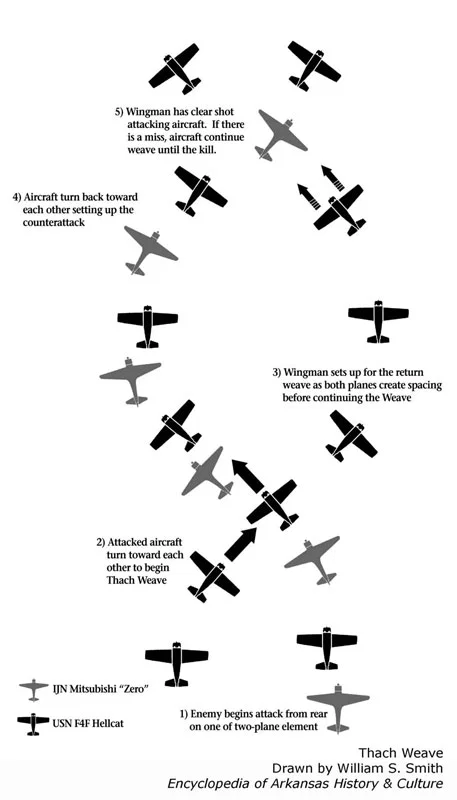
John S. “Jimmy” Thach had been in the Navy since 1927, becoming a Naval Aviator in early 1930. He had served as a test pilot and instructor, and in 1940 was placed in command of Fighting Squadron Three (VF-3), flying the F4F Wildcat. Having studied reports on the manoeuvrability of the Zero, he realised that current US fighter tactics were no match for this formidable new opponent. He therefore developed a defensive manoeuvre he called the beam defense — but had not yet had the opportunity to test it in combat before the Battle of Midway.
On June 4, VF-3 was based aboard USS Yorktown. Thach was assigned to accompany the attack force against the Japanese fleet with six Wildcats — the only American fighters to escort any of the US strike groups that day. Their task was to protect VT-3, Yorktown’s torpedo bombers. Yorktown’s attack force launched later than those from Hornet and Enterprise, but arrived at the Japanese fleet just 30 minutes after the attacks by VT-8 and VT-6.
Staying down with the Devastators in VT-3, they were immediately jumped by Zeros on combat air patrol. Some 20 Zeros went for the six Wildcats while almost as many descended on the torpedo planes. Almost immediately one Wildcat went down in flames. Thach tried to execute his beam defense manoeuvre, but one of his pilots was new to the group and unaware of it — and his radio was not working. Rearranging his flight on the spot, he assigned another pilot to lead the second section, and things began to click. A Zero following one of the Wildcats overshot his first burst and slowed to try again — Thach slid in and shot him down.
The fight continued at a furious pace, but the Zeros could not get at the Wildcats without exposing themselves. Thach shot down two more, a wingman got another, and all five remaining Wildcats were still in the fight. They were kept too busy, however, to help the Devastators — eleven of VT-3’s thirteen planes were lost. It was at this point that the dive bombers arrived. After that the Zero attacks subsided, and Thach led his four surviving planes back to Yorktown, where they flew CAP trying to defend the carrier against the subsequent Japanese strikes.
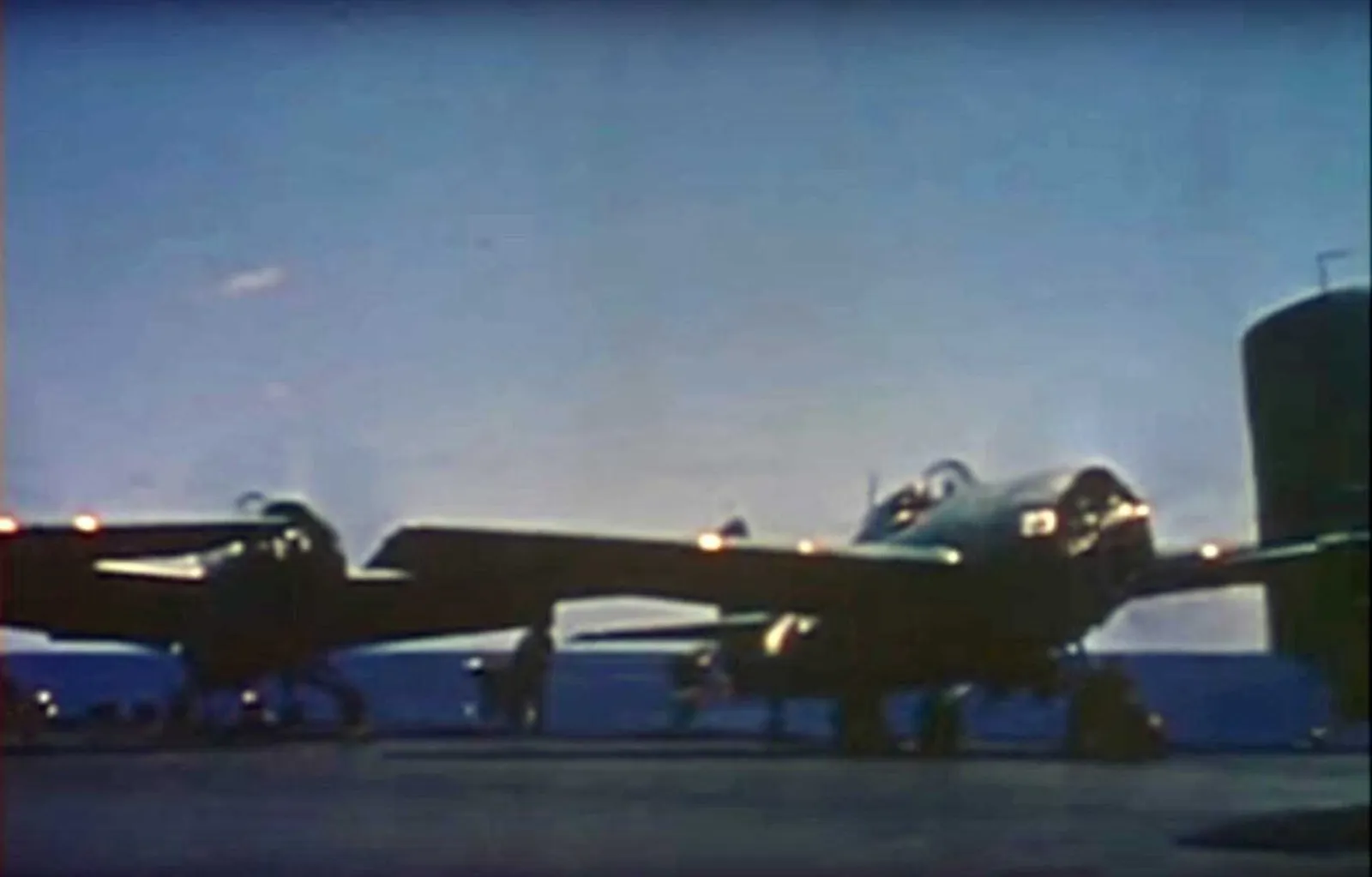
In total VF-3 was credited with 33 enemy aircraft destroyed, 11 probables and 6 damaged during the Battle of Midway — by far the best performance of any fighter group in the battle. The beam defense manoeuvre had been proven in combat for the first time. Later, in an action report from the Battle of Santa Cruz Islands, Commander James H. Flatley named it the Thach Weave. It was widely adopted throughout the rest of the war, proved equally effective during the Vietnam War, and remains a valid dogfighting tactic to this day.
Little is known of the individual experiences of the Japanese fighter pilots in their Zeros during the Battle of Midway. The Mitsubishi A6M2 Zero was the fighter type stationed aboard all four Japanese carriers in the battle. It flew as escort in the attack force that struck Midway on the morning of June 4 — nine aircraft from each carrier, making a total of 36 fighters — and wreaked havoc on the defending forces as described in the previous chapter. But half of the fighter strength was held back for Combat Air Patrol (CAP) to protect the carriers themselves.
The CAP flew continuously throughout the day, parrying the constant attacks described in the preceding chapters. They were highly effective — together with the ships’ AA batteries they managed to shoot down the great majority of the attackers. The first real resistance they encountered came when Jimmy Thach applied his weave, as described in the next chapter.
But then the CAP made their fatal mistake. In their eagerness to shoot down the attacking torpedo planes they all descended to sea level, leaving the skies above completely empty. The consequences are described in the chapter on the SBD-3 Dauntless.
Many Zeros were left without a home carrier after the Dauntless attack. A number were recovered by Hiryū during the afternoon and took part in the subsequent strikes on USS Yorktown, where some were shot down. Then came the attack that set Hiryū ablaze, leaving all airborne Zeros with nowhere to land. They continued flying CAP over what remained of the fleet, but towards 19:00 they began ditching alongside the surviving ships. Most of the pilots were rescued, but for them the battle was over.

While the Midway-based forces were attacking the Japanese fleet, the US carriers began launching their own strike groups. Aboard USS Hornet was Torpedo Squadron 8 (VT-8), equipped with Douglas TBD-1 Devastators — the same squadron to which the six Avengers that had taken off from Midway actually belonged. Now it was the main group’s turn. They were led by Lieutenant Commander John C. Waldron. Among them was Ensign George Henry Gay Jr. with his gunner Aviation Radioman Third Class Robert K. Huntington in their Devastator T-14. At 7:05 they received their orders and Gay was the first in his squadron to take off. It took almost an hour to get all planes airborne and in formation.
USS Hornet’s attack force, led by Lieutenant Stanhope Ring, headed due west on what proved to be a fruitless errand over an empty sea. But Waldron was convinced he knew where the Japanese fleet would be. Telling his men “Just follow me. I’ll take you to ’em,” he broke formation and headed southwest at 8:25.
At 9:18 Waldron and his men spotted the Japanese carrier fleet and descended to attack with their torpedoes. They were immediately swarmed by the 21 Zeros on combat air patrol. One by one the slow Devastators were shot down by fighters or ships’ AA fire. Huntington tried to engage the attackers from his rear gun but soon cried out that he was hit, and the radio went silent. Undeterred by the chaos around him and already wounded himself, Gay took aim at the carrier Kaga and released his torpedo. Realising that turning away at that moment would expose the plane’s underbelly to the carrier’s AA, he continued straight on, turned around Kaga’s island and followed the flight deck, weaving to avoid fire.
Clearing the deck, five Zeros were waiting for him. Finally he pancaked into the water. Surviving the crash he tried to save Huntington, but he was dead. To avoid being strafed Gay dived beneath the surface, and when he came up he found the plane’s uninflated life raft floating nearby, which he tucked between his legs. He also found the black seat cushion from the cockpit, which he held over his head to avoid detection. And so he lay there, alone in the middle of the Japanese carrier fleet, watching the subsequent Devastator attacks fail one by one — his own torpedo had also missed. But then he witnessed something else entirely: the arrival of the Dauntlesses.
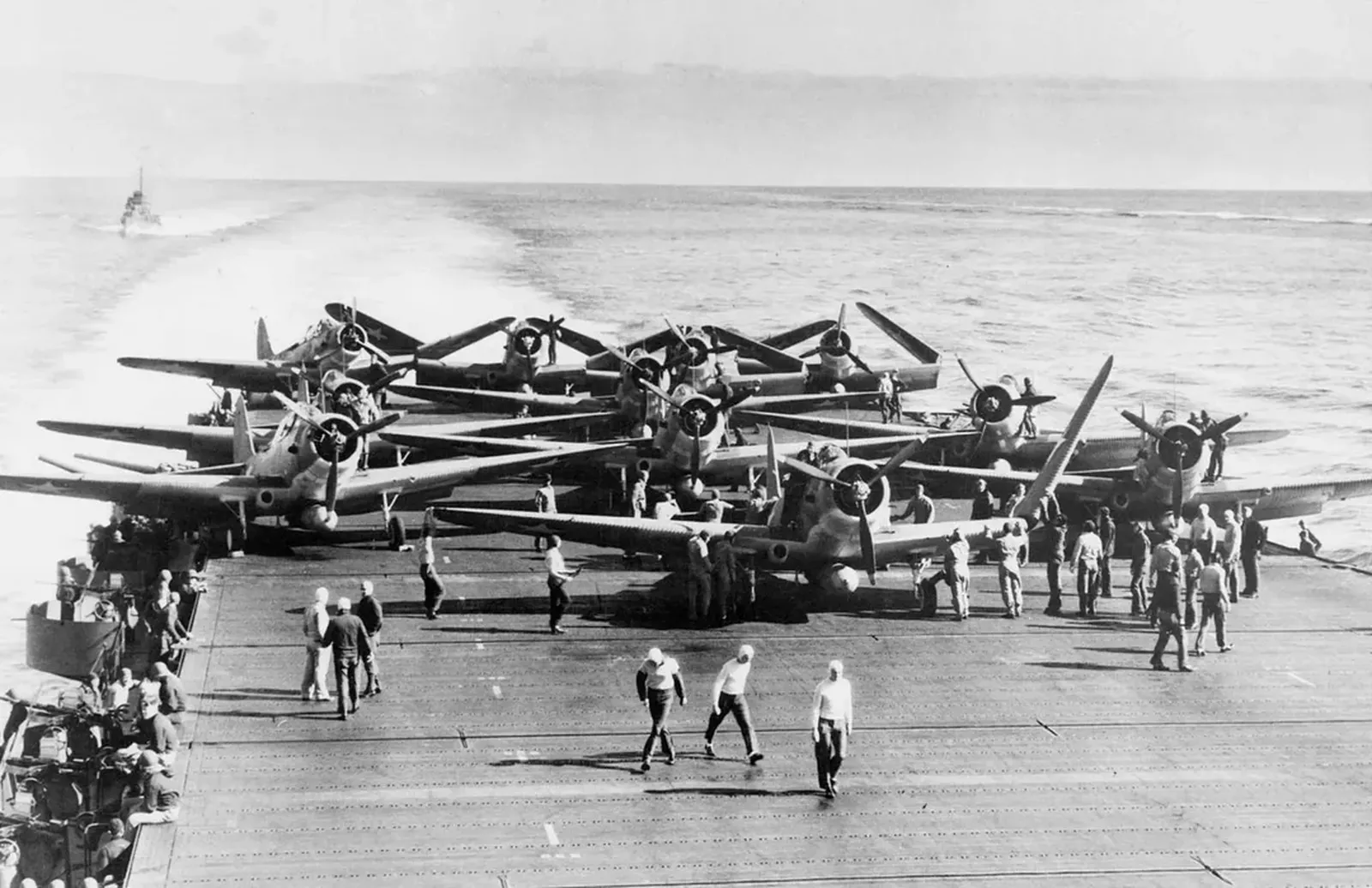
Gay floated there for the rest of the day. When darkness finally fell he dared to inflate the raft — several compartments were punctured by bullets but enough remained to keep him afloat. At 6:20 the following morning he was spotted by a PBY Catalina on reconnaissance, and his position was reported. On the return leg that afternoon the Catalina located him again and, finding no rescue boat had reached him, landed and picked him up. Injured in his left arm and hand and with burns from the crash, he was brought back to Midway.
Of the 15 Devastators in VT-8 all were shot down, and every man but Gay was killed. Of the 41 Devastators sent against the Japanese fleet from Hornet, Enterprise and Yorktown combined, only six returned and not a single torpedo found its mark. Yet their sacrifice was not entirely in vain — as described in the next chapter.
There were 17 B-17E Flying Fortresses stationed at Hickam Field on Midway on June 3, the day before the main battle. When the first traces of the Japanese attack force were found — the invasion fleet spotted by Jack Reid’s Catalina — a B-17 equipped with extra fuel tanks but no bombs was sent out to relieve the Catalina as spotter. Armed with no fewer than eleven guns it was considered far better able to defend itself.
When the enemy fleet was confirmed, nine more B-17s with half a bomb load and extra fuel were dispatched. At 16:23 they sighted the Japanese and went in, approaching in three groups of three at altitudes between 8,000 and 12,000 feet. Met by heavy but tardy AA fire, they released their bombs. No hits were scored.
The next day the B-17s were sent off shortly after the reconnaissance Catalinas at around 4:30, partly as a precaution against the expected attack on the airfield. Since they would need to spend at least four hours airborne regardless, they were redirected to have another go at the invasion force. At 5:52 the Americans finally spotted the main Japanese carrier force and the B-17s were sent after them. They climbed to 20,000 feet and changed course, spotting the first ships at 7:32 but not locating the carriers until 8:10, as they were hidden by clouds. Flying in from the stern they commenced their bomb run. AA fire was heavy and accurate for altitude, though generally behind. The combat air patrol Zeros found the bombers too high to intercept effectively. No hits were scored.
On June 5 three sorties were flown against the remaining Japanese ships. On the last, made by five B-17s at 18:25, they found a lone cruiser and attacked from 11,000 feet. The ship manoeuvred violently and threw up heavy AA fire. During the bomb run one B-17 managed to lose its external fuel tank along with its bombs. The aircraft headed for Midway but at around 23:30 radioed “out of gas and landing” and was never seen again. The remaining planes had trouble finding Midway in the dark — three were guided in by radar, but the last, piloted by Captain Glen H. Kramer, also ran out of fuel and ditched 50 miles short. Everyone but the radio operator was rescued. No hits were scored.
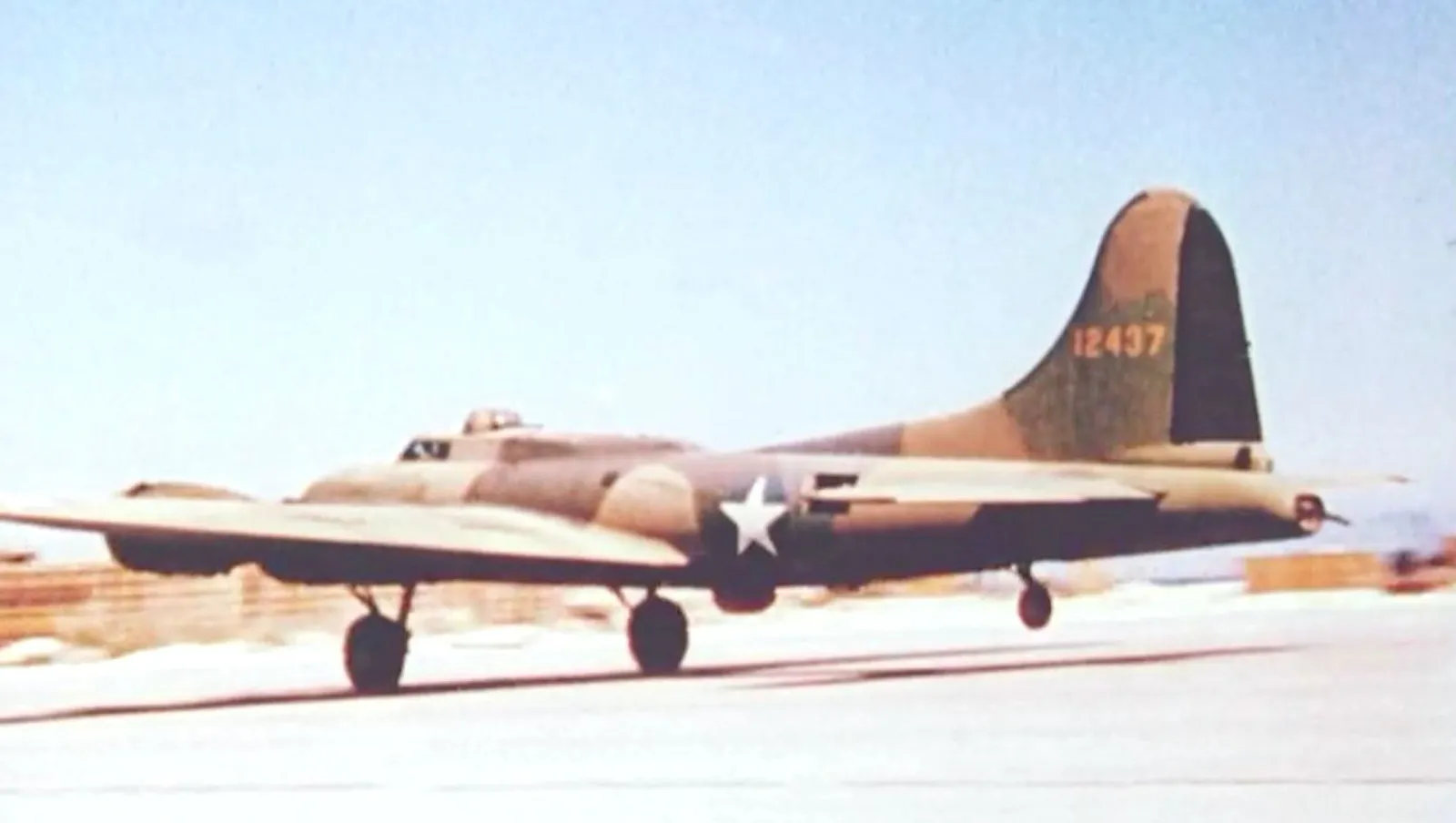
The engagement confirmed that B-17s were better suited to attacking stationary targets than manoeuvring vessels at sea. Their value as long-range reconnaissance platforms, however, was well proven. This individual aircraft (41-2437) was filmed by John Ford for his documentary of the Battle of Midway and appears in several sequences. It had flown in from Hawaii early on June 4, and afterwards was sent on to Australia. On July 17, 1942, it took part in a bombing raid against Rabaul. It was officially written off on June 15, 1944, and scrapped.