Warrant Officer Kenji Yanagiya was a 24-year-old fighter pilot in Kōkūtai 204, flying the Mitsubishi A6M3 Zero. On April 18, 1943, he was assigned to a group of six Zeros tasked with escorting two Mitsubishi G4M Bettys carrying Admiral Yamamoto and his entourage on an inspection tour to Bougainville. They took off at 06:00 Japanese Standard Time from Rabaul, taking up position in two V-formations at Yamamoto’s 4 o’clock, some 500 metres above the Bettys. They were led by Lieutenant Morisaki, and Yanagiya flew alongside P.O. 1/C Tsujinoue, F 1/C Sugita, CPO Hidaka and P.O. 2/C Okazaki. Yanagiya had been assigned plane No. 169. The weather was clear and the flight proceeded smoothly.
After a while Bougainville came into view and they continued toward its southern tip. After about ten minutes they could see their destination — the IJN Ballale Island airstrip — and began their approach. Then, without warning, several aircraft appeared from the direction of Shortland Island to the south. Flying low, their green camouflage made them difficult to spot against the jungle below. They were soon identified as American P-38 Lightnings. The escorts dropped their external tanks and climbed to intercept.
Morisaki wagged his wings and dived to protect the transports. Some P-38s went straight for the Bettys while the rest tried to keep the Zeros occupied. Outnumbered by more than two to one, Morisaki’s group could not keep them away. Yanagiya watched helplessly as one Betty crashed into the jungle and the other splashed into the sea. The Americans then turned back southward. Yanagiya dived toward the airfield and fired a short burst to alert the base — which had not been informed of the inspection visit, as only senior officers had been privy to the itinerary.
Seething with anger, Yanagiya calculated that the Americans had come from Guadalcanal and would cruise low to conserve fuel on the return leg. Heading in that direction he soon found a lone P-38 flying at 12,000 feet. Undetected, he climbed another 1,000 metres above it, then dived and fired a precise burst, every shell finding its mark. The P-38 went down toward the sea trailing heavy white smoke. It was the only American aircraft lost in the entire operation. Yanagiya and all five of his fellow pilots survived the attack, and they were not held responsible for the loss of the Yamamoto flight — their six fighters had been vastly outnumbered by sixteen Americans.
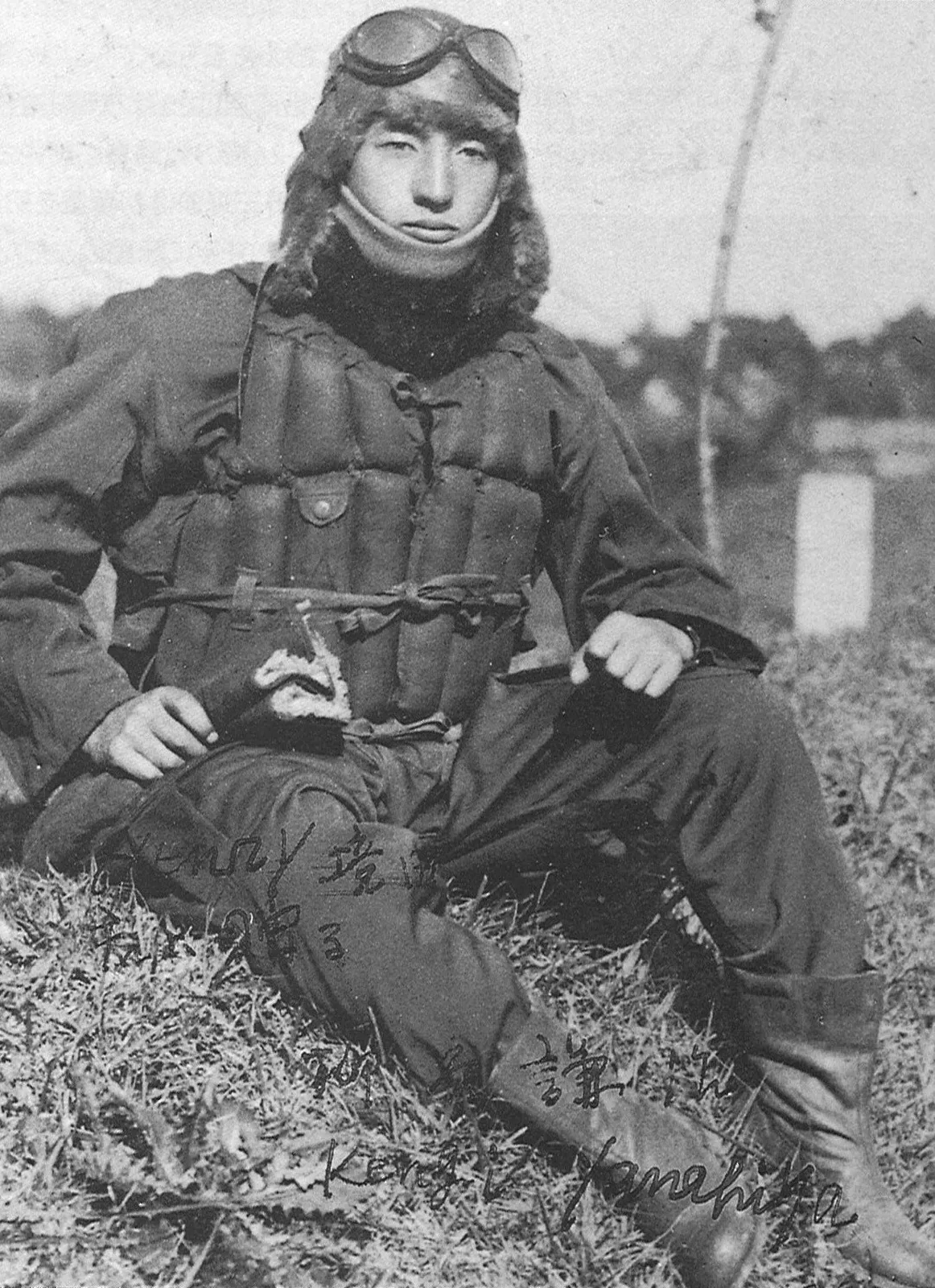
On June 7 the same year Yanagiya’s group was sent on a bombing raid against the Allied airfield on Russell Island. During the action he sustained injuries to his right hand and leg. Managing to limp back to base he made a belly landing. He was operated on and his hand had to be removed, ending his active service. All five of his fellow escorts from the Yamamoto mission were subsequently killed in the war, leaving Yanagiya the sole survivor. Haunted by shame, he kept silent about the events of April 18, 1943, until a documentary writer, Akira Yoshimura, approached him for an interview some thirty years later in the mid-1970s. Yanagiya died on February 29, 2008, at the age of 88.
In the morning of April 18, 1943, Admiral Yamamoto boarded his aircraft, a Mitsubishi G4M1 Model 11 — called Betty by the Americans — at Rabaul. He flew in aircraft 323. A second Betty, aircraft 326, carried Chief of Staff Vice Admiral Matome Ugaki and part of Yamamoto’s staff. They were travelling on a tour to inspect Japanese air units participating in Operation I-Go, which had begun on April 7, 1943. The tour would also serve to boost Japanese morale following the disastrous Guadalcanal Campaign and its evacuation during January and February.
Escorted by six A6M3 Zeros they departed towards Balalae Airfield on an island near Bougainville in the Solomon Islands, a flight of 507 kilometres. They climbed to an altitude of 6,500 feet, with their fighter escort positioned at their 4 o’clock and 1,500 feet higher. The flight was uneventful until they were almost within sight of Balalae. Then, suddenly, a force of enemy fighters appeared. One of them attacked Yamamoto’s plane 323 and poured fire into its right engine, fuselage and tail. When the left engine was also hit the plane began trailing black smoke, rolled over and crashed into the jungle.
The following day, April 19, a Japanese search and rescue party led by army engineer Lieutenant Hamasuna found the wreck. Yamamoto’s body had been thrown clear of the aircraft. He sat in his seat — originally positioned in the cockpit behind the pilot and co-pilot — beneath a tree, slouching as if in deep thought, his katana still clutched in his white-gloved hand. He had been struck by two bullets, one in the shoulder and one to the head. The latter had killed him instantly.
The news of Yamamoto’s death was not made public in Japan until more than a month later, and came as a profound shock to the nation. The Americans spread a cover story that civilian coastwatchers in the Solomons had observed Yamamoto boarding a bomber and relayed the information by radio, concealing the fact that they had broken the Japanese military codes.

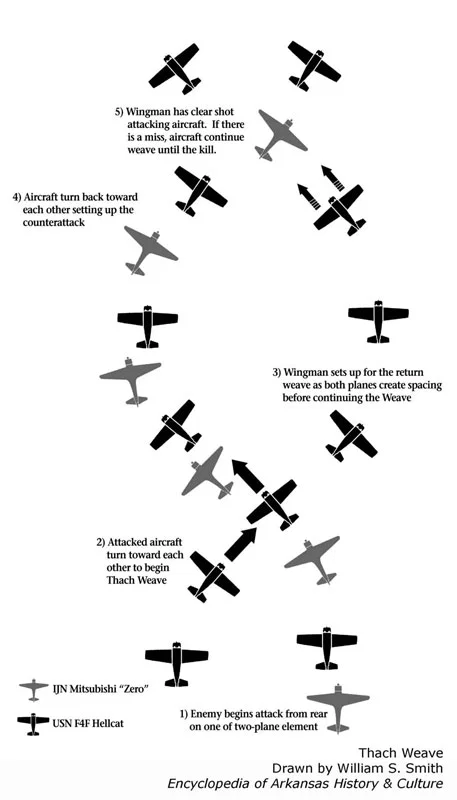
John S. “Jimmy” Thach had been in the Navy since 1927, becoming a Naval Aviator in early 1930. He had served as a test pilot and instructor, and in 1940 was placed in command of Fighting Squadron Three (VF-3), flying the F4F Wildcat. Having studied reports on the manoeuvrability of the Zero, he realised that current US fighter tactics were no match for this formidable new opponent. He therefore developed a defensive manoeuvre he called the beam defense — but had not yet had the opportunity to test it in combat before the Battle of Midway.
On June 4, VF-3 was based aboard USS Yorktown. Thach was assigned to accompany the attack force against the Japanese fleet with six Wildcats — the only American fighters to escort any of the US strike groups that day. Their task was to protect VT-3, Yorktown’s torpedo bombers. Yorktown’s attack force launched later than those from Hornet and Enterprise, but arrived at the Japanese fleet just 30 minutes after the attacks by VT-8 and VT-6.
Staying down with the Devastators in VT-3, they were immediately jumped by Zeros on combat air patrol. Some 20 Zeros went for the six Wildcats while almost as many descended on the torpedo planes. Almost immediately one Wildcat went down in flames. Thach tried to execute his beam defense manoeuvre, but one of his pilots was new to the group and unaware of it — and his radio was not working. Rearranging his flight on the spot, he assigned another pilot to lead the second section, and things began to click. A Zero following one of the Wildcats overshot his first burst and slowed to try again — Thach slid in and shot him down.
The fight continued at a furious pace, but the Zeros could not get at the Wildcats without exposing themselves. Thach shot down two more, a wingman got another, and all five remaining Wildcats were still in the fight. They were kept too busy, however, to help the Devastators — eleven of VT-3’s thirteen planes were lost. It was at this point that the dive bombers arrived. After that the Zero attacks subsided, and Thach led his four surviving planes back to Yorktown, where they flew CAP trying to defend the carrier against the subsequent Japanese strikes.
In total VF-3 was credited with 33 enemy aircraft destroyed, 11 probables and 6 damaged during the Battle of Midway — by far the best performance of any fighter group in the battle. The beam defense manoeuvre had been proven in combat for the first time. Later, in an action report from the Battle of Santa Cruz Islands, Commander James H. Flatley named it the Thach Weave. It was widely adopted throughout the rest of the war, proved equally effective during the Vietnam War, and remains a valid dogfighting tactic to this day.
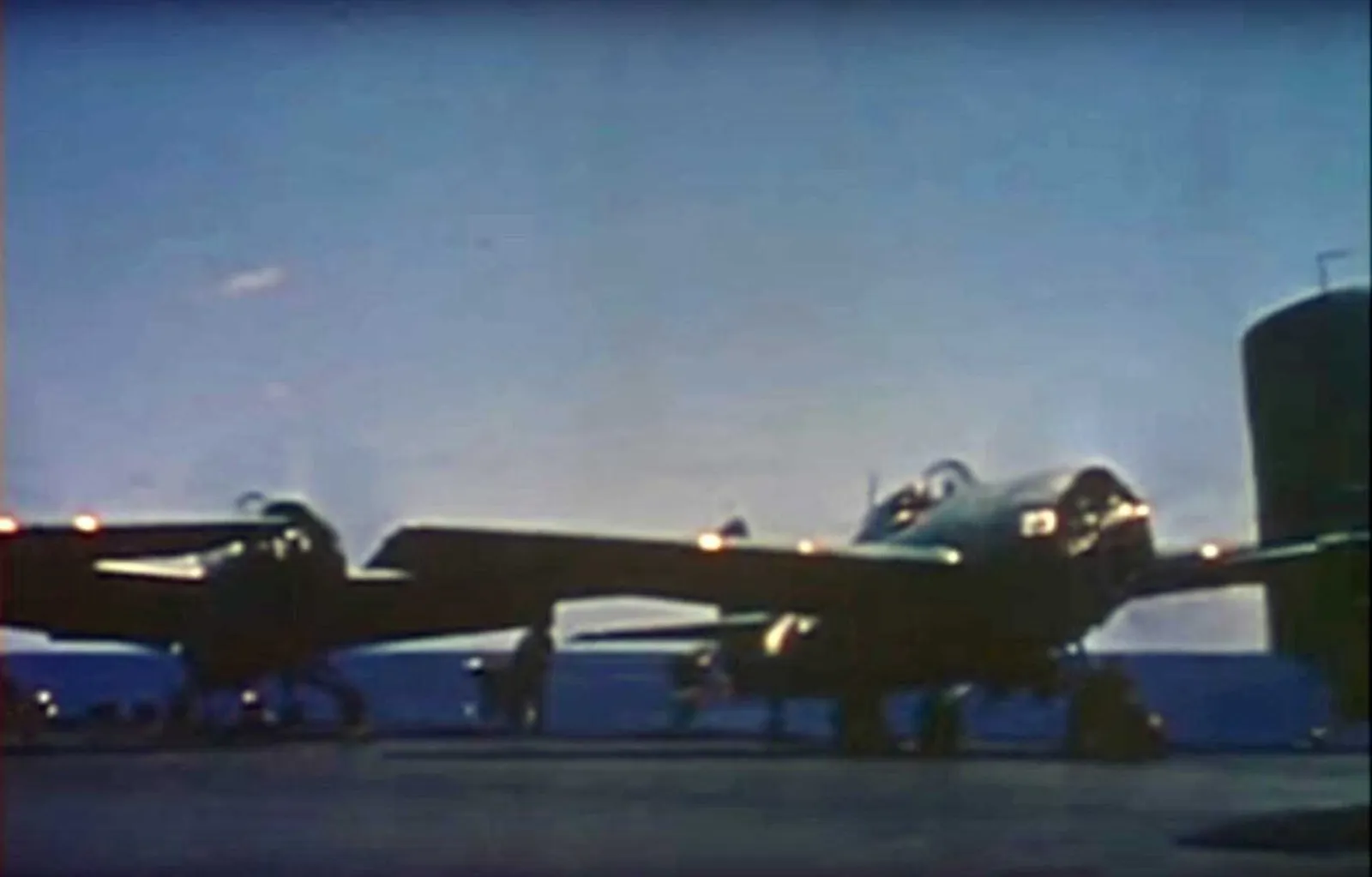
Little is known of the individual experiences of the Japanese fighter pilots in their Zeros during the Battle of Midway. The Mitsubishi A6M2 Zero was the fighter type stationed aboard all four Japanese carriers in the battle. It flew as escort in the attack force that struck Midway on the morning of June 4 — nine aircraft from each carrier, making a total of 36 fighters — and wreaked havoc on the defending forces as described in the previous chapter. But half of the fighter strength was held back for Combat Air Patrol (CAP) to protect the carriers themselves.
The CAP flew continuously throughout the day, parrying the constant attacks described in the preceding chapters. They were highly effective — together with the ships’ AA batteries they managed to shoot down the great majority of the attackers. The first real resistance they encountered came when Jimmy Thach applied his weave, as described in the next chapter.
But then the CAP made their fatal mistake. In their eagerness to shoot down the attacking torpedo planes they all descended to sea level, leaving the skies above completely empty. The consequences are described in the chapter on the SBD-3 Dauntless.
Many Zeros were left without a home carrier after the Dauntless attack. A number were recovered by Hiryū during the afternoon and took part in the subsequent strikes on USS Yorktown, where some were shot down. Then came the attack that set Hiryū ablaze, leaving all airborne Zeros with nowhere to land. They continued flying CAP over what remained of the fleet, but towards 19:00 they began ditching alongside the surviving ships. Most of the pilots were rescued, but for them the battle was over.
