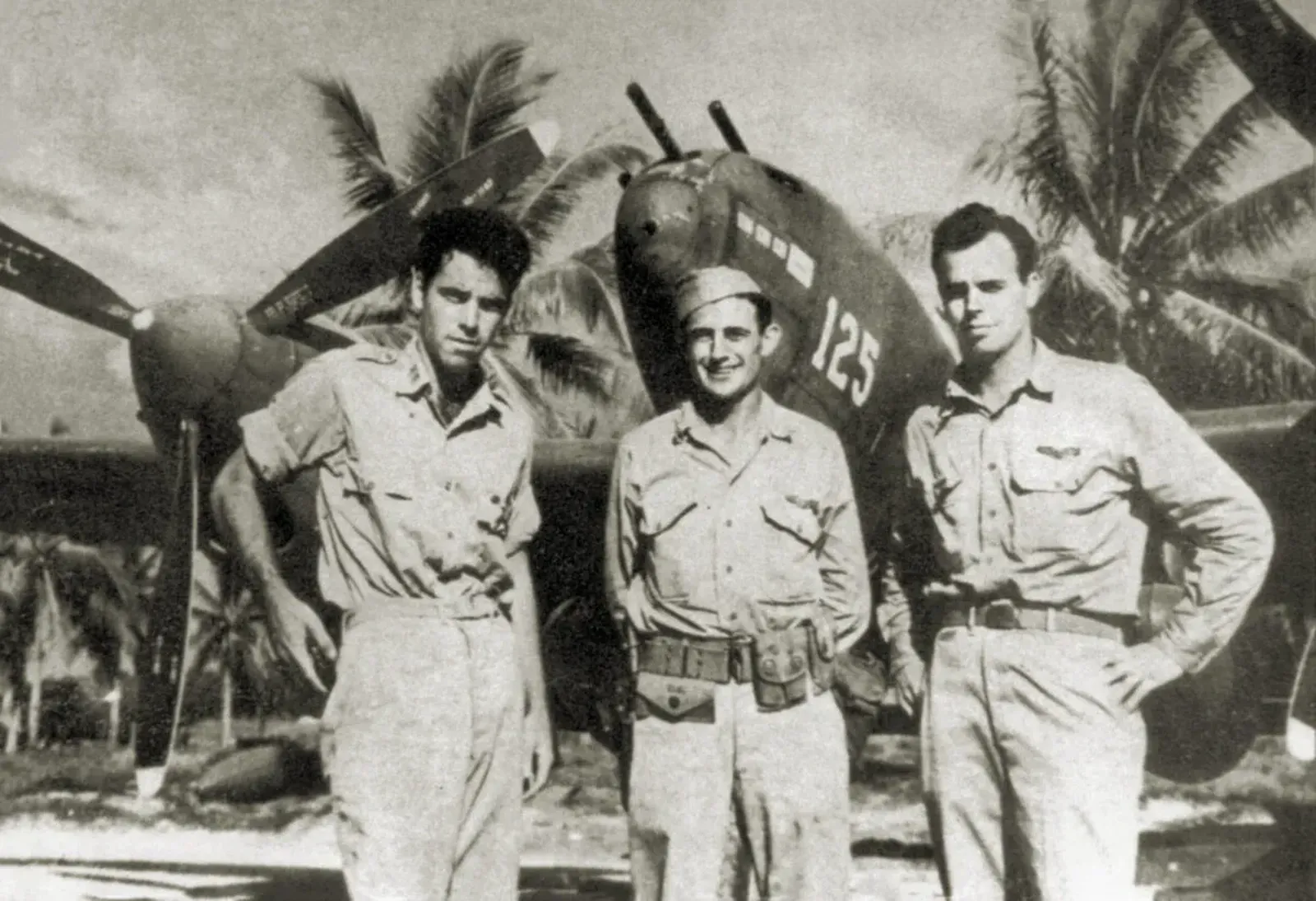
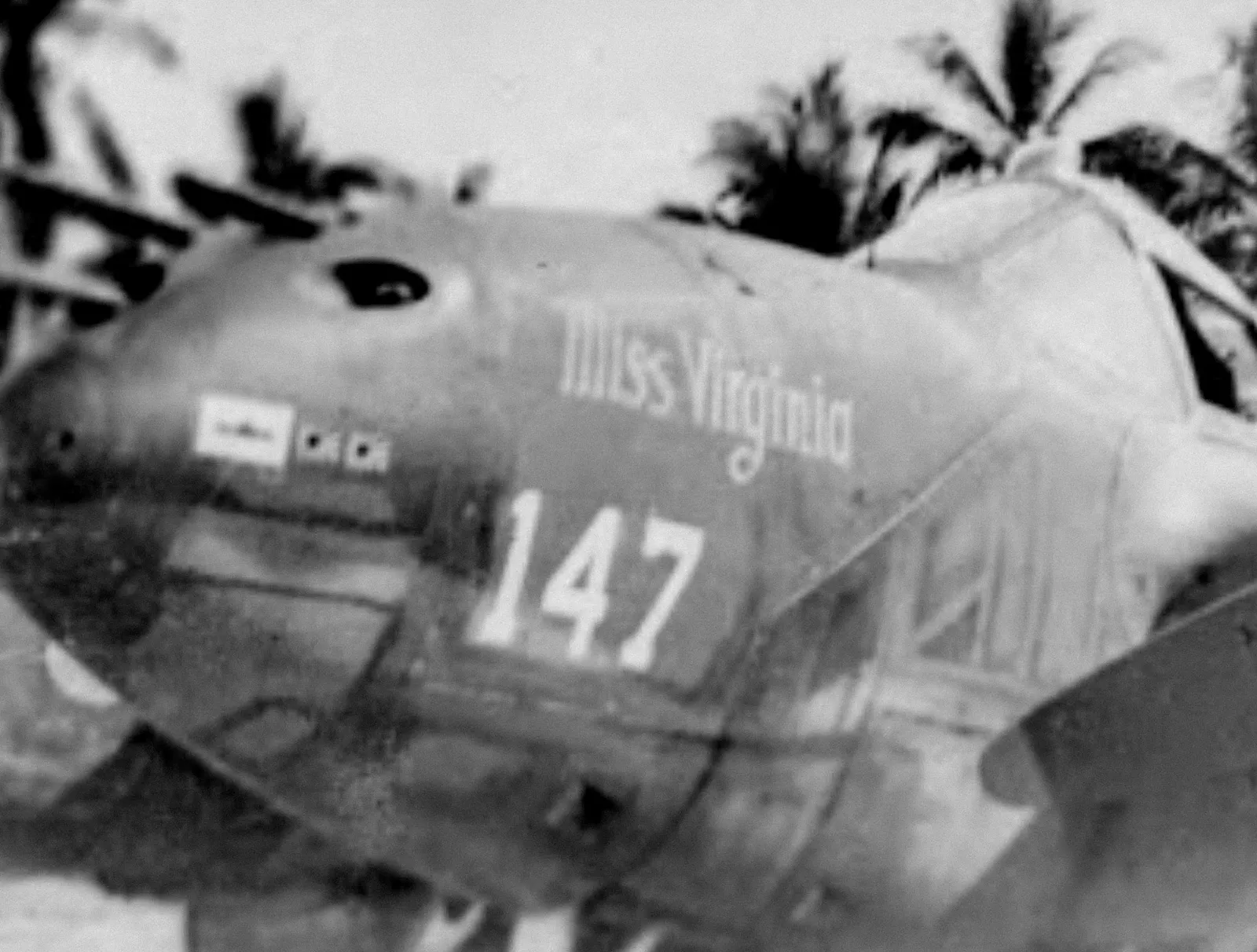
On April 18, 1943 — exactly one year after Doolittle’s famous B-25 raid on Japan — Major John W. Mitchell led a group of P-38 Lightnings on a very special mission. Among them was Lieutenant Rex T. Barber, a 24-year-old pilot who that day flew a P-38 called “Miss Virginia”, the personal plane of Robert Petit, borrowed for the occasion. At the mission briefing they were told that a coastwatcher had spotted an important Japanese high-ranking officer boarding an aircraft at Rabaul and that their task was to intercept his flight. This was a lie, designed to conceal the fact that the Americans had cracked the Japanese military codes and could read their messages. Barber, together with Captain Thomas G. Lanphier Jr., Lt. Jim McLanahan and Lt. Joe Moore, would attack the G4M1 Bettys carrying the prominent passenger, while twelve other P-38s would escort them and fend off any enemy fighters.
Beginning at 07:25 they took off from Kukum Field at Guadalcanal, flying low over the sea on a circuitous route to approach Bougainville from an unexpected direction and avoid detection. McLanahan had to abort due to a tyre puncture and Moore due to a faulty fuel feed. They were replaced by Lt. Besby F. Holmes and Lt. Raymond K. Hine, who had been held in reserve. They arrived at the planned interception point at 09:34, a minute ahead of schedule. Shortly after, the enemy flight — two G4M1 Bettys and six escorting A6M3 Zeros — appeared right on time.
Mitchell ordered the group to drop their external fuel tanks and the kill flight to attack while he led the others to provide cover. Lanphier led the group in a climb toward the target. At the same moment they were spotted by the enemy escort, who dropped their tanks and dived to intercept. Lanphier made a tactical decision and turned directly toward the incoming Zeros, while Barber banked left and went for the Bettys. He came in behind the first and poured fire into its right engine, fuselage and tail. When he hit the left engine the plane began streaming black smoke, rolled heavily and Barber narrowly avoided flying straight into it. The Betty crashed into the jungle.
Barber then spotted the second Betty, already under attack by Holmes and Hine. Holmes hit the right engine, which emitted a white vapour trail, but in doing so he and Hine overshot the target. Barber moved in and raked the fuselage, sending pieces flying — one of which struck his own aircraft. The Betty descended and made a crash landing on the water.
Mission accomplished, they turned for home. Only later did they learn that it had been the famous Admiral Yamamoto — the architect of Pearl Harbour — that they had shot down and killed. After the mission a controversy arose when Lanphier claimed that it was he who had downed Yamamoto’s plane. It was not until the 1990s that Barber’s achievement was officially recognised. Barber later served in China against the Japanese, scoring further victories, was shot down and subsequently rescued by the Chinese resistance. He continued to serve until 1961 and died at his home in 2001 at the age of 84.
As described in the chapter on the Val, Joichi Tomonaga had led the attack on Midway that morning, during which his Kate’s left fuel tank was damaged. He managed to return to his carrier Hiryū. Shortly after, the ship survived the devastating Dauntless attacks that set the Akagi, Kaga and Sōryū ablaze — Hiryū had manoeuvred clear and remained the only operational Japanese carrier. She immediately launched a strike of 18 Vals and 6 Zeros against USS Yorktown, which had been located by a reconnaissance plane from the cruiser Chikuma. The attack was met with fierce resistance — thirteen Vals and three Zeros were shot down — but they still managed to score several hits on the Yorktown.
Soon after, one of Sōryū’s Judys returned with the startling news that there were in fact three American carriers in the vicinity. A new strike force was quickly assembled under Tomonaga’s lead, consisting of 10 Kates and 6 Zeros. His left fuel tank was still perforated, and he was asked to switch to another aircraft. He refused, pointing out that every plane was needed. He simply ordered the ground crew to fill his right tank and took off, fully aware that he had fuel for a one-way trip only.
They were ordered to attack one of the two undamaged American carriers, targeting the Yorktown only if the others could not be found. Around 14:00 they sighted what appeared to be an undamaged carrier — it was in fact the Yorktown, which had been so swiftly repaired that Tomonaga mistook her for a fresh ship. At 14:32 he radioed his group: “Take position in preparation for attack formation,” and two minutes later: “Entire force attack!” On the way in two Wildcats shot down one Kate before being themselves brought down by the escorting Zeros. Closing in, the American CAP descended upon them and the AA fire intensified.

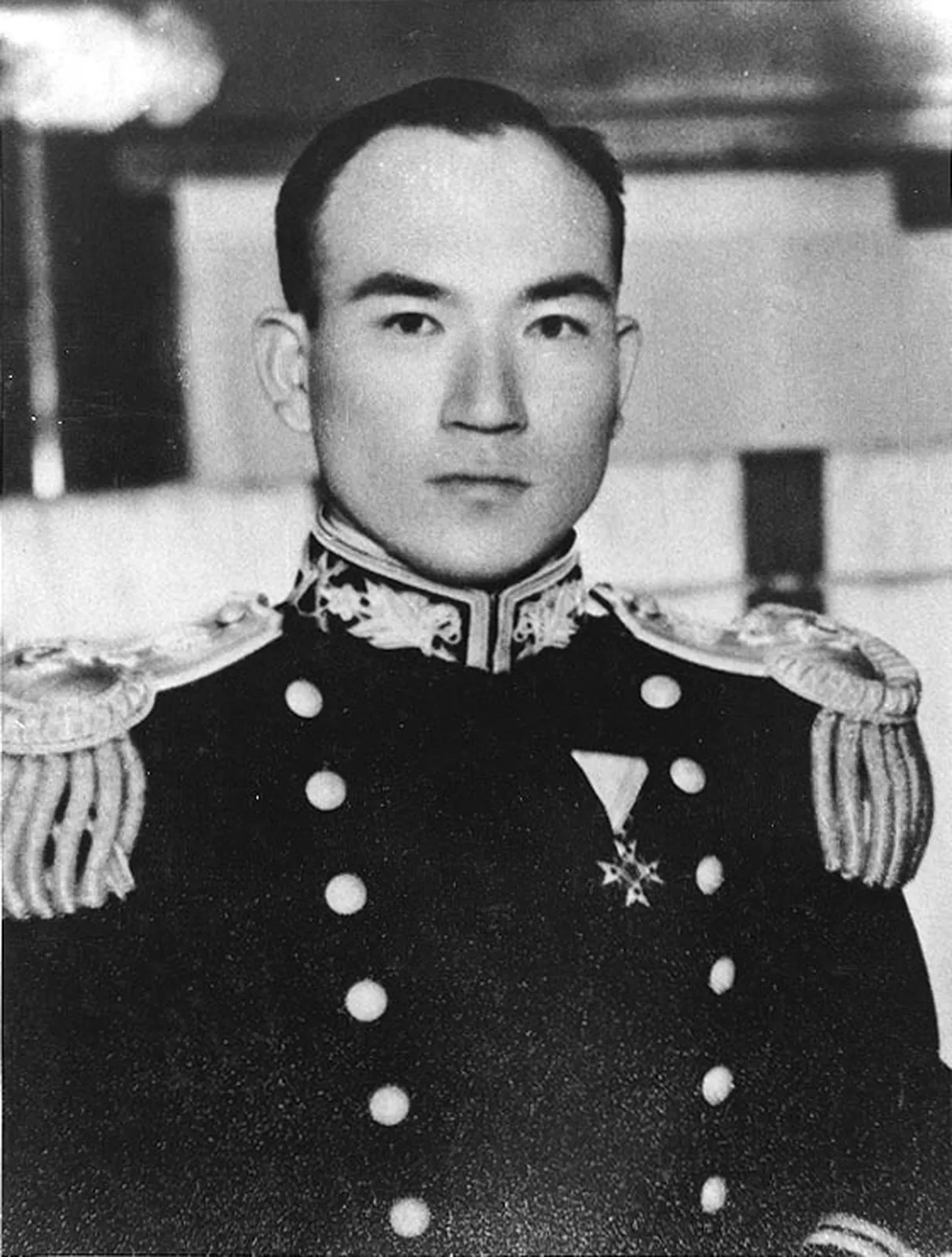
Tomonaga came in on the Yorktown from the aft port quarter, a Wildcat on his tail — possibly Jimmy Thach himself. Heavily damaged, he held his course and released his torpedo against the carrier. Immediately afterwards his left wing ruptured and he crashed into the sea. His torpedo missed its mark.
The Yorktown was nevertheless hit by two other torpedoes, one dropped by Lieutenant Toshio Hashimoto, leader of the second group of Kates. The hits crippled her so severely that she was later finished off by the Japanese submarine I-168. Hiryū did not escape either — that afternoon she was attacked by American dive bombers and eventually sunk, bringing the battle’s carrier exchange to a decisive conclusion.
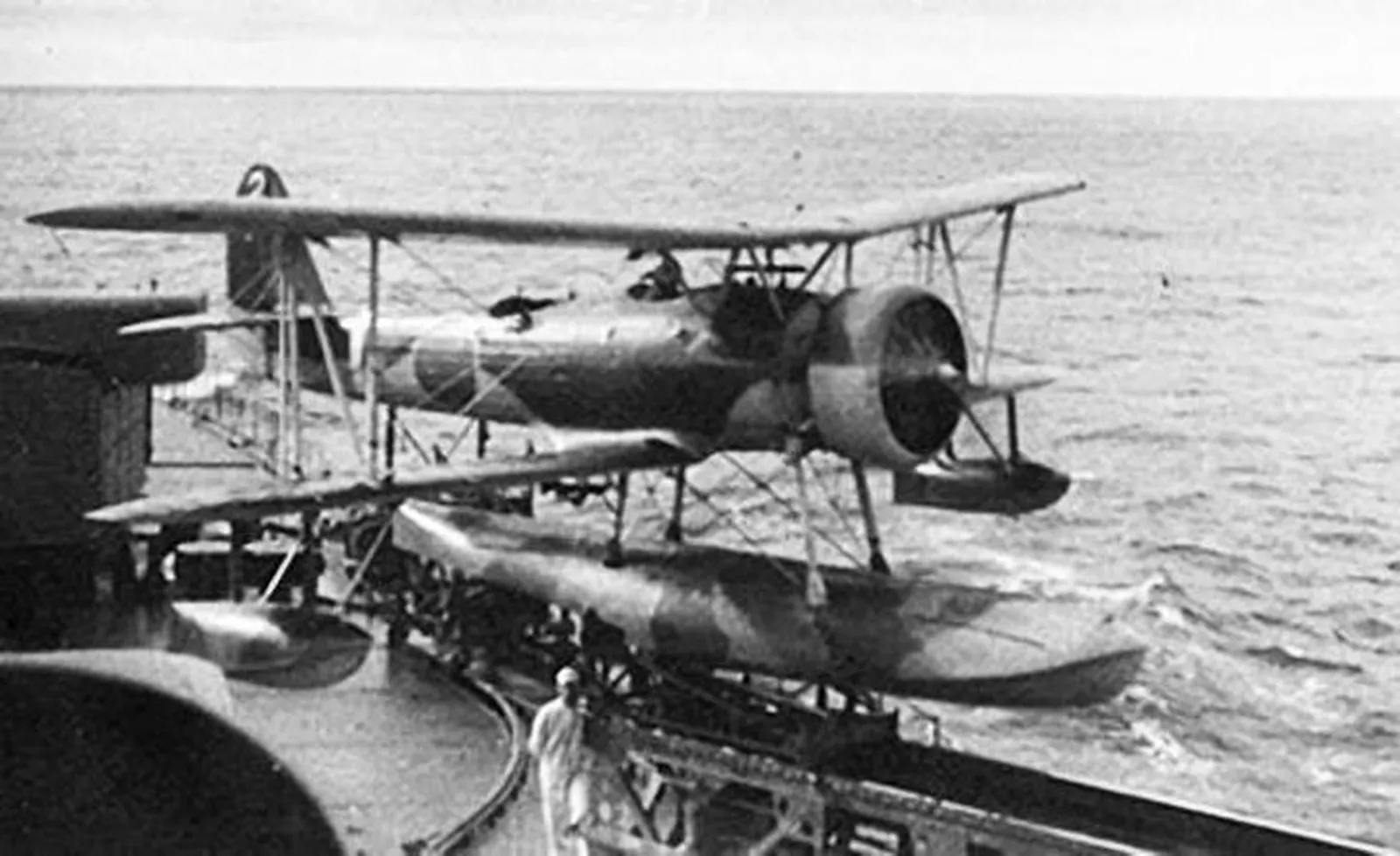
By the afternoon the Japanese knew there were more American carriers in the vicinity than they had initially thought — but how many? They launched several scout planes to find out. In addition to the Jakes and the Judy already described, five Nakajima E8N2 ‘Dave’ floatplanes were sent out from the tender Tone and the battleships Haruna and Kirishima. These were slower and had shorter range than the other scouts, but every available resource was now needed. Among them was No. 1 aircraft from the battleship Haruna.
Just as reports reached Rear Admiral Yamaguchi aboard Hiryū about Tomonaga’s attack on the Yorktown, a message came in from Haruna’s No. 1 scout. He was under attack by American fighters and believed carriers to be close by. The scout was considered as good as lost — an E8N2 was hardly a match for an American Wildcat.
The unnamed pilot aboard No. 1, however, turned out to possess exceptional airmanship. Rather than trying to outrun his pursuers, he used his plane’s very slowness to his advantage, manoeuvring to deny the faster American fighters a clean shot. With some cloud cover available he finally managed to shake them off. Limping back to the Japanese fleet he found his way to the Haruna. His observer/gunner had been killed, and the E8N2 would never fly again — but the pilot had survived against all odds.
On the morning of June 4 the two US carrier forces — Task Force 16 with USS Enterprise and USS Hornet, and Task Force 17 with USS Yorktown — began launching their strikes against the Japanese fleet. Hornet’s attack force under Commander Stanhope Ring headed off on an inexplicably erroneous course far to the north of the Japanese fleet, a still unexplained blunder that cost many planes and crews to fuel exhaustion. Only their torpedo squadron VT-8, which broke away from the main force after half an hour, managed to find the Japanese — as described in the previous chapter.
Meanwhile the dive bombers from Enterprise and Yorktown searched for the enemy. They headed for the expected position of the Japanese carriers, but the carriers had turned northeast toward the American fleet, and valuable fuel was burned trying to locate them. In the formation led by Lieutenant Commander Wade McClusky flew Lieutenant Commander Richard Halsey “Dick” Best, leading VB-6. When they failed to find the enemy at the expected position, McClusky turned northwest, where they spotted a lone Japanese destroyer steaming at full speed to the northeast. It was the Arashi, which had been detailed to suppress the American submarine Nautilus after it had attempted to attack the Japanese carriers. Now it was heading back to rejoin the fleet. McClusky guessed correctly and followed — arriving directly over the Japanese carriers just as they were being attacked by VT-3’s Devastators and the CAP had descended to sea level.
During the flight one of Best’s men had run out of oxygen, forcing VB-6 down to 15,000 feet — below McClusky’s VS-6. Doctrine dictated that the leading group attack the farthest target and the second group the nearest. Best prepared to dive on the nearest carrier, the Kaga, and began opening his dive flaps — when McClusky, a former fighter pilot, came screaming down in front of them, breaking doctrine entirely. Most of VB-6 followed him. Realising the error, Best managed to pull away with just two wingmen — Lieutenant Edwin John Kroeger and Ensign Frederick Thomas Weber — and continued toward the second carrier, the Akagi.
They commenced their attack still unopposed, but Akagi’s AA guns soon opened up. It was too late. Going in loose V-formation against the turning carrier, the first bomb missed by a mere ten metres, sending a plume of water over the bridge. The third also narrowly missed, striking aft and damaging the rudder. But Best’s bomb — the second — hit Akagi’s flight deck just aft of the midship elevator. The 1,000-lb bomb penetrated the deck and exploded in the upper hangar, setting fire to the B5N2 Kates being readied there. The Akagi was doomed.
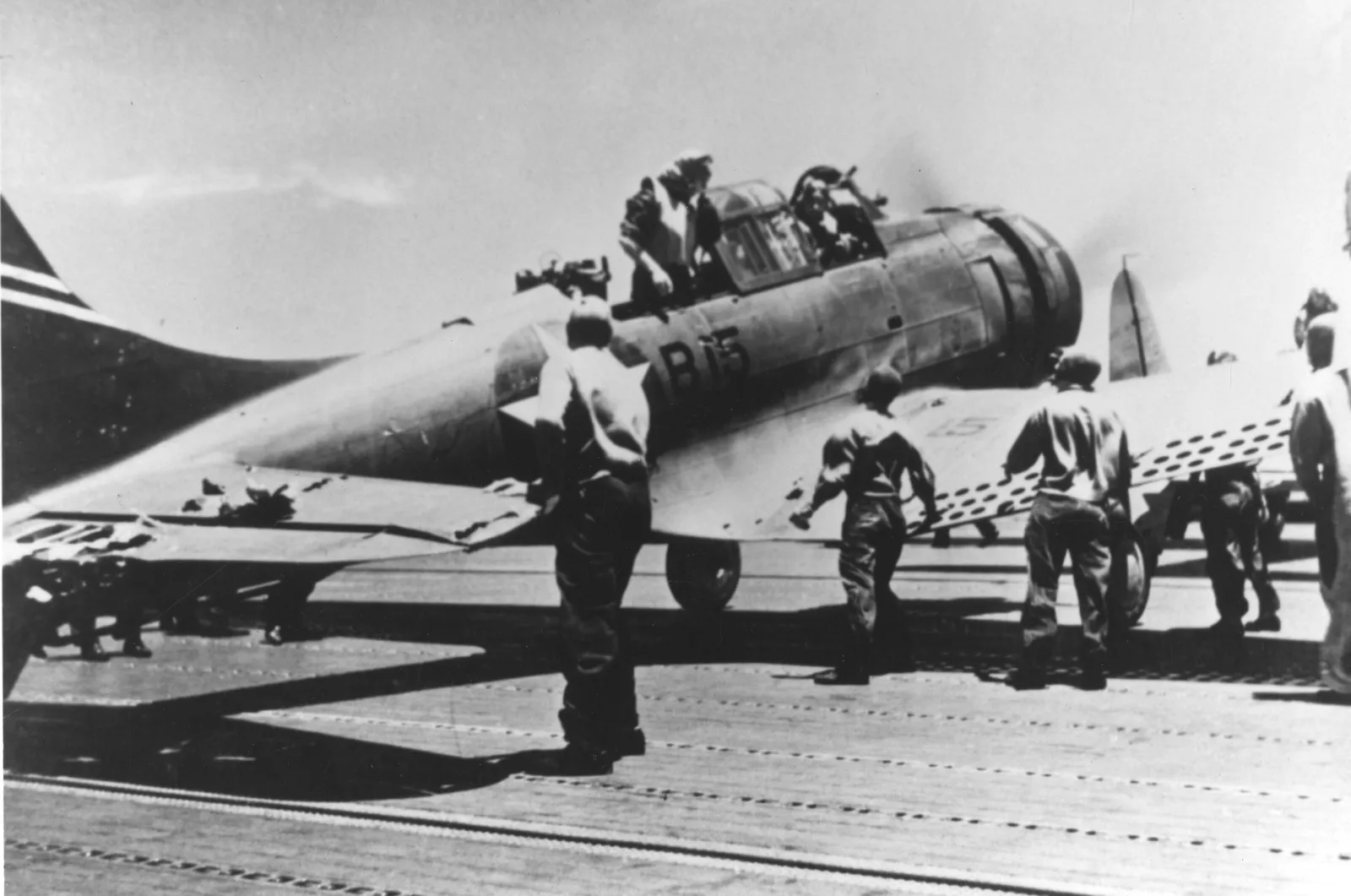
The rest of VB-6 and VS-6 had set the Kaga ablaze with a 1,000-lb and at least three 500-lb bombs. Meanwhile Dauntlesses from VB-3 off USS Yorktown had arrived from a different direction and attacked the Sōryū, scoring no fewer than three hits with 1,000-lb bombs and setting her ablaze as well. Of the four Japanese carriers at Midway, only Hiryū remained operational.
In the afternoon the Dauntlesses were off again. The force was led by Lieutenant Commander Wilmer Earl Gallaher in VS-6 with six planes, Best led VB-6 with four, and they were joined by fourteen Dauntlesses from VB-3, which had been diverted to Enterprise after Yorktown was hit. This time they found Hiryū immediately. The Japanese were ready, and the attackers were met by CAP and every AA gun the fleet could bring to bear. The first bombs from VS-6 missed. As Best prepared to attack, VB-3 broke off from their assigned target — the battleship Haruna — to go after Hiryū instead, but they too missed. Then Best and his group attacked. This time they hit. Hiryū was struck by four 1,000-lb bombs, one of them Best’s. The last carrier’s fate was sealed.
Dick Best had during his first mission that morning breathed oxygen contaminated with caustic soda. The day after he began coughing blood — the fumes had reactivated a latent tuberculosis. He spent 32 months in military hospitals before being retired from service in 1944. In his last day of action he had mortally struck two different enemy carriers, earning him a Distinguished Flying Cross and a Navy Cross. Speaking with characteristic good humour about the day he sank two Japanese fleet carriers and ended his career as a Navy pilot, Best later remarked: “You couldn’t end a career better than that in 30 or 40 years!”
Little is known of the individual experiences of the Japanese fighter pilots in their Zeros during the Battle of Midway. The Mitsubishi A6M2 Zero was the fighter type stationed aboard all four Japanese carriers in the battle. It flew as escort in the attack force that struck Midway on the morning of June 4 — nine aircraft from each carrier, making a total of 36 fighters — and wreaked havoc on the defending forces as described in the previous chapter. But half of the fighter strength was held back for Combat Air Patrol (CAP) to protect the carriers themselves.
The CAP flew continuously throughout the day, parrying the constant attacks described in the preceding chapters. They were highly effective — together with the ships’ AA batteries they managed to shoot down the great majority of the attackers. The first real resistance they encountered came when Jimmy Thach applied his weave, as described in the next chapter.
But then the CAP made their fatal mistake. In their eagerness to shoot down the attacking torpedo planes they all descended to sea level, leaving the skies above completely empty. The consequences are described in the chapter on the SBD-3 Dauntless.
Many Zeros were left without a home carrier after the Dauntless attack. A number were recovered by Hiryū during the afternoon and took part in the subsequent strikes on USS Yorktown, where some were shot down. Then came the attack that set Hiryū ablaze, leaving all airborne Zeros with nowhere to land. They continued flying CAP over what remained of the fleet, but towards 19:00 they began ditching alongside the surviving ships. Most of the pilots were rescued, but for them the battle was over.

Leader of the dive bombers that attacked Midway was Lieutenant Takehiko Chihaya in his Aichi D3A1 Type 99 ‘Val’ dive bomber AI-251, accompanied by 35 others. The whole attack force was led by Navy Lieutenant Joichi Tomonaga in his Nakajima B5N2 Type 97 ‘Kate’ torpedo bomber, followed by another 35 ‘Kates’, all escorted by 36 Mitsubishi A6M Zero fighters. After breaking through the fighter defence in front of Midway they arrived over the atoll at 6:20 in the morning.
First came the ‘Kates’. They were dismayed to find their primary target — the planes at Midway — gone. The airfield was almost devoid of aircraft, as the Americans had sent their forces off to attack the Japanese fleet or simply get them out of harm’s way. The Kates went ahead and attacked their secondary target, the anti-aircraft defences, to clear the way for the Val dive bombers. They scored a direct hit on three oil storage tanks on the north-eastern tip of Sand Island, sending a massive column of oily black smoke high into the air — smoke that would later serve as a landmark for American stragglers trying to find their way back to Midway.
The AA fire was fierce and two of the Kate’s was shot down. Tomonaga’s plane also received a hit damaging his fuel tanks. He managed to get back to the carrier Hiryū while radioing back to Admiral Nagumo that a second air attack on Midway was needed.
Next it was time for Lieutenant Takehiko Chihaya and the Val dive bombers. The lead Val pealed off and dove down to about 100 feet and turned upside down and proceeded down the airfield. The AA crews were astonished by this stunt and stood there staring until someone cried “What the hell, let’s go at him.” and opened fire downing the plane. This was the only Val shot down during the attack. The others came down dropping their bombs on the islands. One struck VMF-221’s rearming pit setting off eight 100-pound bombs and 10,000 rounds of ammunition killing four maintenance personnel.
Despite the spectacle, the attack was indecisive. Only twenty men had been killed, camouflage had effectively protected the 5-inch coastal guns, and most of the damage to installations was repairable. The runways had received so little damage that Captain Simard, the US Navy commander, suspected the Japanese had deliberately spared them for their own use once the atoll was captured.
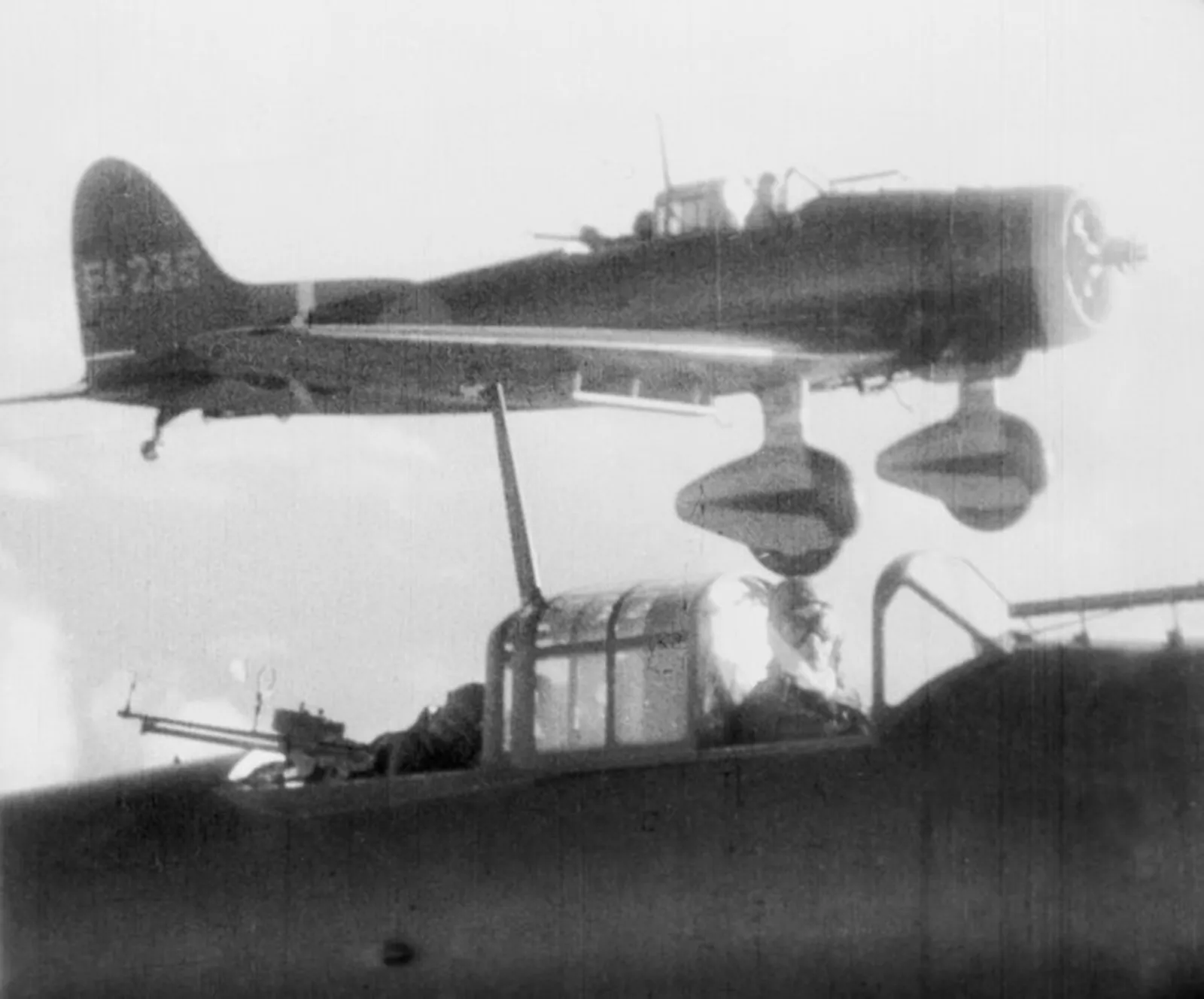
After at first receiving a hot welcome by the Japanese AA-crews in their own fleet, Chihaya landed back on Akagi fairly sizzling with indignation. “A gunnery officer who mistakes friendly planes for the enemy should be fired!” he shouted. He and his colleague Lieutenant Yamada reported to the bridge, advising that, contrary to Japanese Intelligence data, there were three air strips on the island.